

Illinois Medical Malpractice Lawyer

Atty. John Fotopoulos is your medical malpractice lawyer in Illinois, providing compassionate and dedicated legal representation to those injured by negligent medical care.
Fotopoulos Law Office
60 W. Randolph St, 4th Floor, Chicago, Illinois 60601
Phone: 312-213-3955
An Illinois Medical Malpractice Lawyer Dedicated To Protecting the Rights of Patients and Their Families After Negligent Medical Care
At Fotopoulos Law Office, we recognize that when healthcare providers act with negligence or recklessness, and the consequences for patients are often life-altering.
Our legal team is dedicated to holding negligent parties accountable for the harm they cause, ensuring that victims have the resources necessary to manage their recovery. We will help you with your medical malpractice claim in Illinois. Simply call us today to get started. Find our telephone number on this page, click it, and get a free consultation with Fotopoulos Law Firm. We serve many, many areas, including Chicago, Orland Park, Glen Ellyn, Morris, and surrounding neighborhoods, cities, and counties.
Work with a Medical Malpractice Lawyer in Illinois Today
If you believe you or a loved one has suffered due to a medical malpractice in Illinois, understanding your legal options is the first step toward recovery. Medical mistakes can devastate lives, leaving families to deal with the physical and financial fallout of someone else’s negligence. At Fotopoulos Law Office, we are here to help guide you through the complexities of pursuing compensation for your case.
Contact us today at 708-942-8400 for a complimentary consultation. We understand the financial strain medical issues can cause, which is why there are no upfront fees when working with us; you only pay if we successfully collect compensation for you. Our representation extends to medical malpractice victims across the entire state of Illinois, including Cook County, Will County, and all surrounding regions.
What Makes Atty. John Fotopoulos’ Background Beneficial for Medical Malpractice Claims in Illinois?
Medical malpractice in Illinois is one of the most complex areas of civil law in the state.
Medical malpractice in Illinois requires more than just a basic understanding of personal injury; they demand a lawyer with a deep-seated knowledge of the judicial system, a rigorous commitment to research, and an analytical approach to complex evidence. Attorney John S. Fotopoulos brings a unique trifecta of experience—as a former judge, an accountant, and a veteran trial lawyer—that makes him an invaluable asset to victims of medical negligence.
The Judicial Perspective
Perhaps the most significant advantage Mr. Fotopoulos offers is his tenure as a retired Judge in the Circuit Court of Cook County. In medical malpractice cases, procedural mastery is essential. Having sat on the bench, John understands exactly how judges evaluate motions, how they view expert testimony, and what it takes to succeed in a courtroom environment. This “view from the bench” allows him to anticipate the opposition’s strategies and prepare a case that resonates with the court’s expectations.
Analytical and Financial Rigor
Before earning his J.D. from the John Marshall Law School in 2000, John Fotopoulos earned a B.S. in Accounting from the University of Illinois at Chicago. This financial background is particularly beneficial in medical malpractice claims, where calculating damages—such as future medical costs, loss of earning capacity, and life-care planning—requires precise quantitative analysis. His ability to dissect complex financial records ensures that no detail is overlooked when pursuing maximum compensation for his clients.
The medical field is constantly evolving, and so is the law that governs it. John takes immense pride in staying ahead of the competition by fulfilling extensive credits in continuing education seminars. His dedication to “fresh perspectives” prevents the stagnancy that often plagues long-standing firms. By combining tireless legal research with his membership in elite organizations like the Illinois Trial Lawyers Association, he ensures his clients receive the most modern and comprehensive legal protection available.
Accessibility and Affordability
Navigating a medical malpractice suit is inherently stressful. John founded his firm on the principles of competitive rates and constant availability. He understands that litigation defense and personal injury battles can be overwhelming, and his goal is to provide high-level legal counsel that remains accessible to everyone. With honors like the “10 Best Client Satisfaction Award” and an Avvo 10.0 rating, his track record proves that he prioritizes the human element of every legal battle, allowing his clients to return to their normal lives while he tackles the complexities of the Illinois legal system.
Recognizing Medical Malpractice in Illinois
Medical care is designed to heal, yet a breakdown in communication, protocol, or judgment can result in severe physical and emotional trauma. These errors are not limited to hospital settings; they can occur in private clinics, outpatient centers, pharmacies, or during home-based care. For many Illinois families, the period following a medical error is defined by confusion and a search for answers.
Why Identifying Medical Errors is Difficult
One of the primary hurdles in these cases is that negligence is not always immediately apparent. While some errors, such as a surgical mistake, may be noticed shortly after a procedure, others take months or years to manifest. For instance, a failure to diagnose a progressive illness may only become clear when the condition reaches an advanced and less treatable stage.
Furthermore, human health is multifaceted. Factors such as genetics, pre-existing conditions, and lifestyle choices can complicate the process of determining exactly what caused a patient’s health to decline. Distinguishing between a known medical complication and a preventable error requires a meticulous review of medical records and a thorough understanding of the standard of care required in the Illinois medical community.
Illinois Medical Malpractice Laws and Negligence Claims
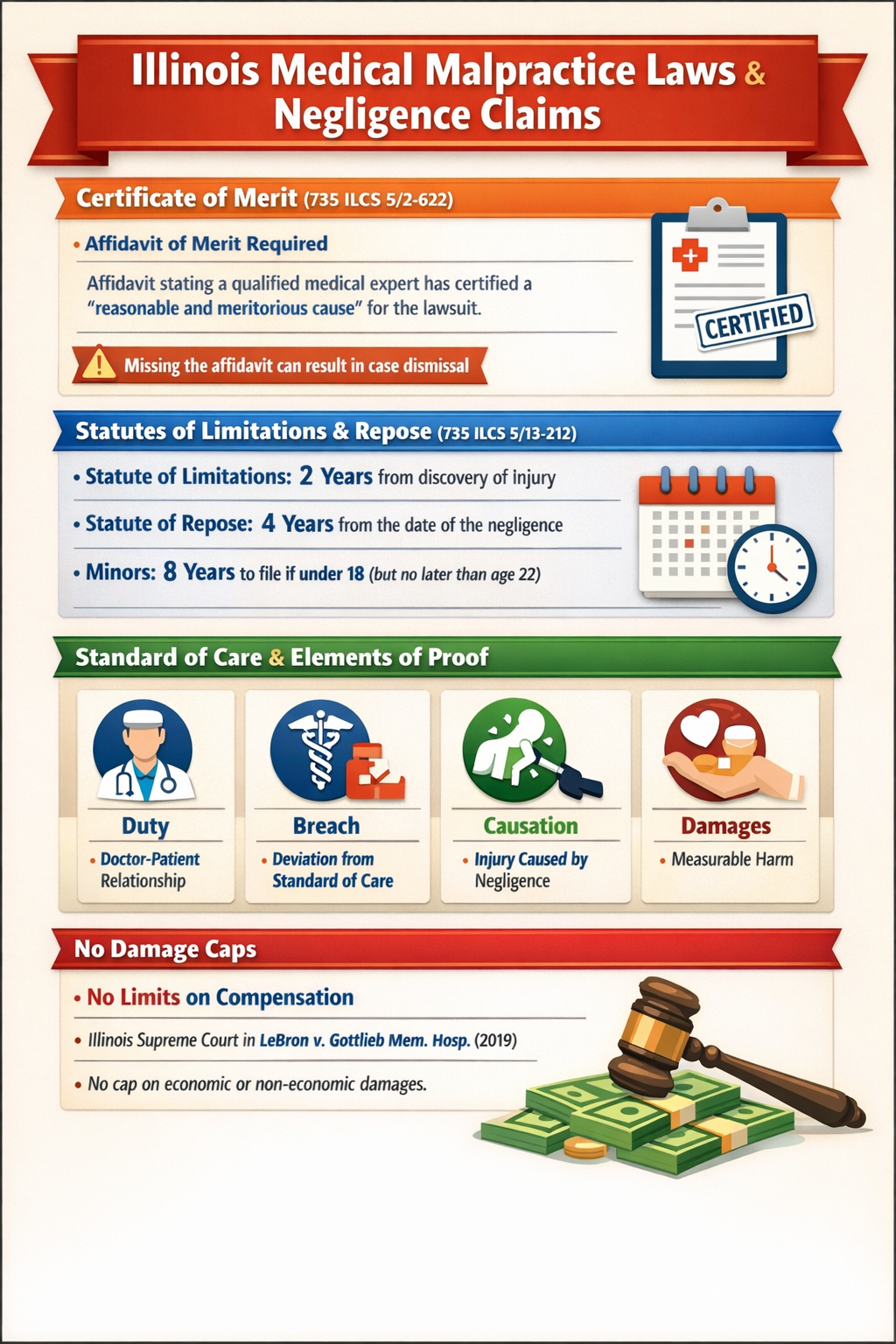
Medical malpractice claims in Illinois are primarily governed by the Illinois Code of Civil Procedure (735 ILCS). These laws establish strict procedural hurdles, timelines, and evidentiary requirements that differ significantly from standard personal injury cases.
The Certificate of Merit (735 ILCS 5/2-622)
One of the most critical requirements in Illinois is the Affidavit of Merit. Under Section 2-622, a plaintiff (or their attorney) must file an affidavit alongside the initial complaint. This document must state that a qualified healthcare professional has reviewed the medical records and determined there is a “reasonable and meritorious cause” for the lawsuit. Failure to include this expert report can lead to the immediate dismissal of the case.
Statutes of Limitations and Repose (735 ILCS 5/13-212)
Illinois law sets strict deadlines for filing a claim:
- Statute of Limitations: Generally, a lawsuit must be filed within two years from the date the patient knew, or reasonably should have known, of the injury.
- Statute of Repose: Regardless of when the injury was discovered, a claim cannot be filed more than four years after the date the alleged negligence occurred.
- Minors: If the victim was under 18, they typically have eight years from the date of the incident to file, but no claim can be brought after the individual turns 22.
Standard of Care and Elements of Proof
To succeed, a plaintiff must prove four elements:
- Duty: A physician-patient relationship existed.
- Breach: The provider deviated from the Standard of Care (the level of skill and care a “reasonably careful” professional would use in similar circumstances).
- Causation: The breach was the proximate cause of the injury.
- Damages: The patient suffered measurable harm.
No Damage Caps
While Illinois previously attempted to limit “non-economic” damages (such as pain and suffering), the Illinois Supreme Court ruled these caps unconstitutional in the 2010 case LeBron v. Gottlieb Memorial Hospital. Consequently, there is currently no limit on the amount a jury can award for economic or non-economic losses in Illinois malpractice cases.
Common Categories of Medical Mistakes
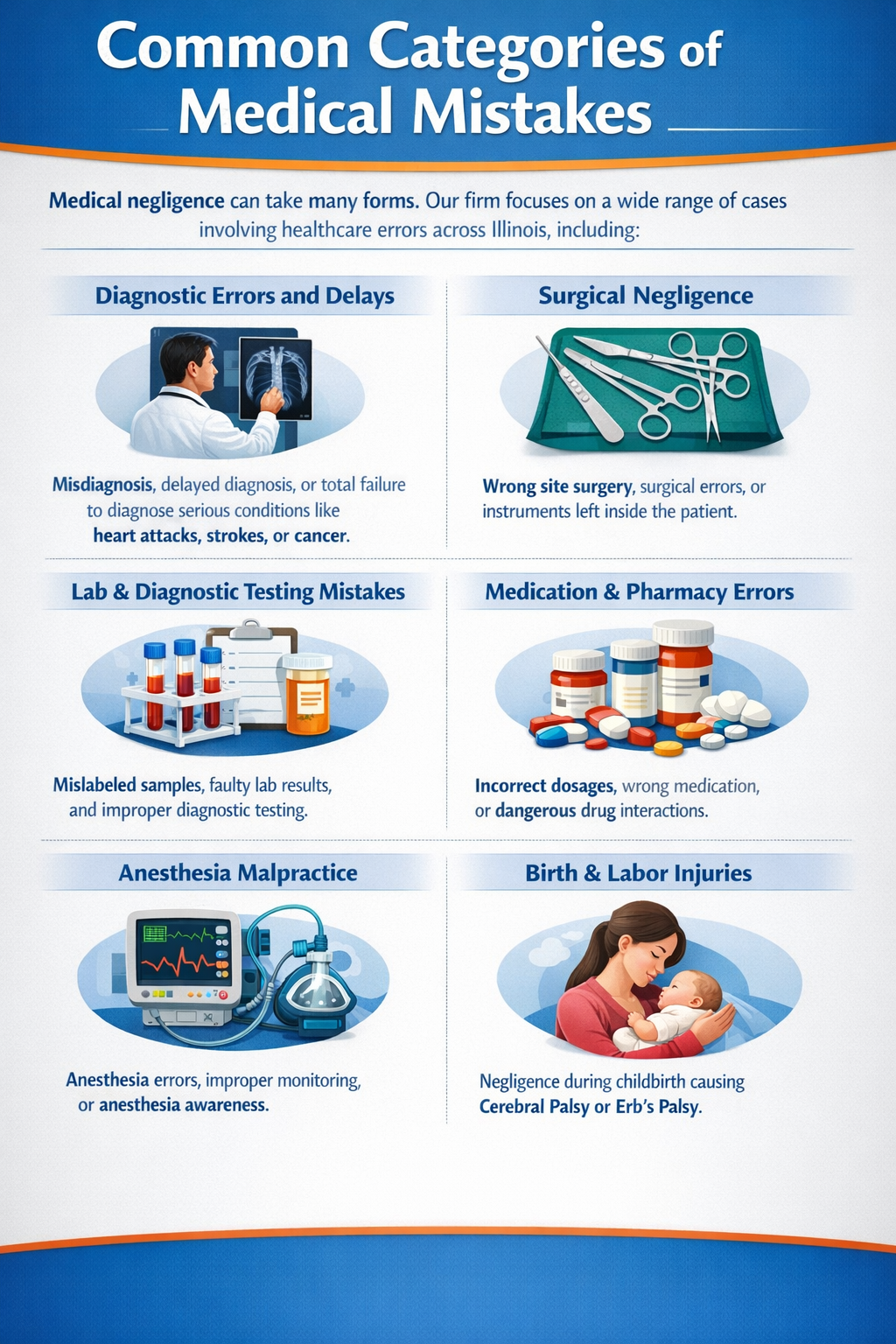
Medical negligence can take many forms. Our firm focuses on a wide range of cases involving healthcare errors across Illinois, including:
Diagnostic Errors and Delays
A significant portion of malpractice claims involves misdiagnosis, delayed diagnosis, or a total failure to diagnose. This occurs when a physician fails to recognize symptoms that a professional with similar training would have identified. In cases of heart attacks, strokes, or aggressive cancers, a delay of even a few days can be the difference between a full recovery and a permanent disability or fatality.
Surgical Negligence
Operating rooms are high-pressure environments that require seamless coordination. Mistakes during surgery can include performing the wrong procedure, operating on the incorrect site, or leaving foreign objects like sponges inside a patient. Additionally, damage to internal organs or nerves during a procedure can lead to chronic pain and the need for multiple corrective surgeries.
Laboratory and Diagnostic Testing Mistakes
Medical decisions are heavily reliant on lab results. When samples are mislabeled, results are incorrectly entered into a patient’s file, or equipment is not properly maintained, the entire treatment plan is compromised. This can lead to patients receiving unnecessary treatments or being denied the care they actually need.
Medication and Pharmacy Errors
Errors involving medication can happen at the prescribing level, the pharmacy level, or during administration by nursing staff. Whether it is an incorrect dosage, the wrong medication entirely, or a failure to check for dangerous drug interactions, the results can be toxic. These errors are particularly dangerous for pediatric and elderly patients whose systems may be less resilient to chemical imbalances.
Anesthesia Malpractice
Anesthesia is a critical component of modern surgery but requires constant, vigilant monitoring. If an anesthesiologist fails to review a patient’s history for allergies, administers an incorrect dose, or fails to monitor vital signs during a procedure, the patient may suffer brain damage, cardiovascular distress, or “anesthesia awareness,” where they remain conscious but paralyzed during surgery.
Birth and Labor Injuries
Negligence during the birthing process can have a lifelong impact on both the mother and the child. This may involve a failure to recognize fetal distress, improper use of delivery tools like vacuum extractors, or a delay in ordering a necessary C-section. Such mistakes often result in conditions like Cerebral Palsy or Erb’s Palsy, requiring a lifetime of medical intervention and support.
Why Illinois is a Frequent Venue for Medical Malpractice Litigation?
Illinois is a medical malpractice litigation hub due to its complex healthcare networks, staffing shortages, and a lack of damage caps on settlements. High-volume urban centers like Cook County frequently see “system failures” and administrative errors. Given the state’s stringent filing requirements and two-year statute of limitations, specialized legal counsel is essential for navigating these high-stakes negligence claims.
The Complexity of the Illinois Healthcare System
Illinois is home to some of the largest and most complex healthcare networks in the country, including major teaching hospitals and sprawling university-affiliated systems. While these institutions provide cutting-edge care, the sheer scale of operations—often involving thousands of staff members and a high volume of patients—increases the margin for error. In teaching hospitals, the involvement of residents and interns can sometimes lead to lapses in supervision, resulting in diagnostic errors or surgical complications.
Key Factors Contributing to Malpractice Trends in Illinois
Several specific factors have given rise to Illinois’ reputation for high malpractice activity:
- Urban vs. Rural Disparity: A significant concentration of cases occurs in Cook County. The high density of patients and facilities, combined with juries in urban areas that historically award larger settlements, contributes to the state’s high financial totals.
- Systemic Staffing Issues: Like much of the country, many Illinois facilities face nursing and support staff shortages. Overworked providers are more prone to “fatigue-induced” errors, such as medication mismanagement or failure to monitor vital signs.
- Lack of Damage Caps: Unlike many other states that have enacted “tort reform” to limit the amount a patient can recover for non-economic damages (such as pain and suffering), Illinois currently has no such caps. This allows for substantial verdicts that more accurately reflect the life-altering nature of a patient’s injury.
- Administrative Errors: Many cases arise not from a single doctor’s mistake, but from “system failures”—lost lab results, poor communication during shift changes, or inadequate discharge instructions.
Illinois Medical Malpractice: Frequently Asked Questions
1. What constitutes medical malpractice under Illinois law?
Medical malpractice occurs when a healthcare provider deviates from the accepted standard of care, resulting in patient injury. To succeed in a claim, one must prove a physician-patient relationship existed, the provider breached their duty through negligence, this breach directly caused the injury, and the patient suffered measurable damages. This legal framework ensures that negligent medical professionals are held accountable.
2. What is the Statute of Limitations for these claims?
In Illinois, a medical malpractice lawsuit must generally be filed within two years from the date the patient knew, or reasonably should have known, of their injury. This timeline is strictly enforced by the court system. Failing to file within this window usually results in the permanent loss of the right to seek compensation for the specific medical negligence involved.
3. Does Illinois have a Statute of Repose for malpractice?
Yes, Illinois law includes a Statute of Repose for medical negligence cases. Regardless of when an injury is discovered, a claim cannot be filed more than four years after the date the alleged negligence actually occurred. This serves as an absolute deadline for adults, intended to provide a final limit on the potential liability of healthcare providers within the state.
4. Are there different filing deadlines for injured minors?
If the victim of medical malpractice was under the age of 18 at the time of the incident, they are granted more time. Generally, they have eight years from the date of the incident to file a claim. However, Illinois law dictates that no claim can be brought after the individual reaches the age of 22, regardless of the circumstances.
5. What is the Section 2-622 Certificate of Merit?
The Certificate of Merit is a mandatory procedural requirement under the Illinois Code of Civil Procedure. A plaintiff must file an affidavit stating that a qualified healthcare professional has reviewed the medical records and determined a “reasonable and meritorious cause” for the suit exists. Without this expert report, the court will likely dismiss the malpractice case at the initial stage.
6. Does Illinois limit the compensation a patient can receive?
Currently, Illinois does not have “damage caps” on medical malpractice settlements or jury verdicts. While the state previously attempted to limit non-economic damages, such as pain and suffering, the Illinois Supreme Court ruled these limits unconstitutional in 2010. This allows victims to recover the full value of their economic losses and the true human cost of their life-altering injuries.
7. Why is identifying medical errors often a difficult process?
Negligence is not always immediately apparent because human health is multifaceted and complex. While surgical mistakes might be noticed quickly, failures to diagnose progressive illnesses may take years to manifest. Distinguishing between a known medical complication and a preventable error requires a meticulous review of medical records and a deep understanding of the professional standards required in the medical community.
8. How do staffing shortages contribute to Illinois medical errors?
Many Illinois healthcare facilities face significant nursing and support staff shortages, leading to systemic failures. Overworked providers are more prone to “fatigue-induced” errors, such as mismanaging medication or failing to monitor vital signs properly. These administrative and systemic issues often result in a breakdown of patient safety, particularly in high-volume urban medical centers like those in Cook County.
9. What are the common risks associated with anesthesia malpractice?
Anesthesia requires constant, vigilant monitoring of a patient’s vital signs and history. If an anesthesiologist fails to check for allergies, administers an incorrect dose, or ignores distress signals, the results can be catastrophic. Patients may suffer permanent brain damage, cardiovascular distress, or even “anesthesia awareness,” a traumatic state where they remain conscious but paralyzed during a major surgical procedure.
10. What defines a diagnostic error in a malpractice case?
A diagnostic error occurs when a physician fails to recognize symptoms that a professional with similar training would have identified. This includes misdiagnosis, delayed diagnosis, or a total failure to diagnose conditions like heart attacks or cancer. In aggressive illnesses, a delay of even a few days can be the difference between recovery and permanent disability or a fatality.
11. What types of mistakes commonly occur during surgical procedures?
Surgical negligence involves high-stakes errors during operations, such as performing the wrong procedure or operating on the incorrect site. Surgeons or staff might also leave foreign objects, like sponges or tools, inside a patient’s body. Additionally, accidental damage to internal organs or nerves during the process can lead to chronic pain and the necessity for multiple corrective surgeries.
12. What are the long-term consequences of birth and labor injuries?
Negligence during childbirth can have a lifelong impact on both the mother and the child. Mistakes such as failing to recognize fetal distress or delaying a necessary C-section can lead to permanent conditions like Cerebral Palsy. These injuries often require a lifetime of medical intervention, specialized therapy, and significant financial resources to manage the child’s ongoing health and development.
Read More:
What are the Elements of a Medical Malpractice Claim in Illinois?
Claiming Medical Malpractice When You Have Been Misdiagnosed
4 Things to Be Aware of Before Filing a Medical Malpractice Case
Can I File a Malpractice Lawsuit Against My Doctor for a Misdiagnosis?