
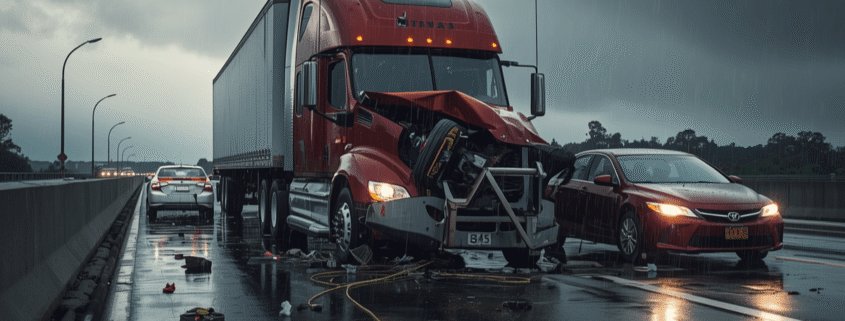
Morris, IL Truck Accident Lawyer | Fotopoulos Law Office
I-80 cuts across northern Grundy County, and in any given hour a meaningful share of the truck traffic is feeding Morris-area logistics — the Costco Meat Plant, RJW Logistics, Pactiv Evergreen, the Minooka warehouse cluster — or passing through to the Joliet intermodal complex to the east. When trucks crash here, the case is immediately different from an ordinary auto case. Federal regulations apply that don’t apply to passenger cars, evidence sits on retention schedules measured in weeks rather than years, and multiple corporate defendants beyond the driver typically carry their own insurance coverage. Fotopoulos Law Office represents drivers and passengers hurt in commercial truck crashes throughout Morris. Attorney John Fotopoulos, who previously served as a Cook County Circuit Court Judge, leads our legal team. Call (708) 942-8400 for a free, no-obligation consultation.
Why are Morris truck accident cases not like ordinary car accident cases?
Morris truck accident cases involve a body of federal regulation that ordinary auto cases never touch. The Federal Motor Carrier Safety Regulations under 49 CFR Part 395 govern driver hours, vehicle inspection, maintenance, driver qualifications, and recordkeeping for interstate motor carriers. A semi crash on I-80 is not simply a bigger fender-bender. It is a case in a different legal universe.
The regulatory layer matters because federal rules supplement Illinois common-law negligence. A trucking company that violated FMCSA hours-of-service rules — by pressuring a driver past the eleven-hour daily driving limit, by allowing an exceeded fourteen-hour duty cycle, by not enforcing the thirty-minute break requirement — isn’t just at fault under Illinois law. It is also out of compliance with federal regulation, which can serve as evidence of negligence per se in some contexts and as evidence of corporate-level disregard in all of them.
The insurance structure is also different. Where a personal auto policy might carry the Illinois minimum 25/50/20 coverage, federal motor carrier regulations under 49 CFR § 387.9 require interstate carriers of general freight to maintain minimum public liability coverage of $750,000. Most carriers carry $1 million in primary coverage and add excess and umbrella layers on top. For hazardous materials transport, the federal minimum jumps to $5 million. The available recovery in a serious car accident case may be capped by a personal driver’s policy limits; in a Morris truck accident case, the coverage is typically several orders of magnitude larger.
What evidence disappears within thirty days of a Morris truck crash?
A commercial truck involved in a Morris crash carries a body of electronic evidence that documents exactly what happened in the seconds and hours before impact. Most of it sits on retention schedules measured in weeks or months, not years. Without prompt action, the most decisive evidence in the case is gone before a complaint is ever filed.
The Event Data Recorder — part of the truck’s engine control module, often called the “black box” captures pre-impact speed, braking inputs, throttle position, steering angle, and other vehicle dynamics in the seconds before a crash. EDR data can be overwritten in as little as thirty days if the truck is returned to service. Data parameters are set by the National Highway Traffic Safety Administration; admissibility in Illinois courts is governed by Federal Rule of Evidence 702. None of that matters if the data has already been overwritten by the time anyone asks for it.
The Electronic Logging Device records the driver’s duty status, on-duty time, off-duty time, sleeper-berth time — at one-minute intervals. Federal regulation 49 CFR § 395.8 requires motor carriers to retain ELD records for six months. The standard preservation request asks for the eight-day lookback window that includes the day of the crash plus the seven preceding days, which is the window that establishes whether the driver was within or beyond hours-of-service limits at the moment of impact.
Beyond EDR and ELD data, several other categories of evidence deserve early attention. Dashcam footage, where the carrier maintains it, is typically retained for a fixed period that varies by carrier. Driver qualification files maintained under 49 CFR Part 391 — medical certificates, road test certificates, prior employer verifications — are kept for the duration of employment plus three years. Driver vehicle inspection reports under 49 CFR Part 396 document mechanical issues identified before the crash. Maintenance records, dispatch records, and bills of lading round out the documentary picture.
A preservation letter — sent to the motor carrier within days of the crash, often within twenty-four to forty-eight hours where possible — is what protects this evidence. Without it, gaps routinely appear at exactly the points that mattered most. With it, the carrier is on notice that destroying or losing the evidence creates spoliation exposure separate from the underlying liability claim.
Who can be held responsible for a Morris truck accident besides the driver?
A Morris truck accident usually involves more than one potentially liable party. The driver is the obvious defendant, but the motor carrier that employed the driver, the broker or shipper that arranged the load, the maintenance contractor responsible for the truck’s mechanical condition, and sometimes the company that loaded the cargo all carry their own potential exposure under different theories of liability.
The motor carrier sits at the center of most of these cases. Carriers are vicariously liable for their drivers under respondeat superior when the driver was acting within the scope of employment. They are also directly liable for negligent hiring when the driver had a known unsafe history, negligent retention when the carrier kept a driver on after warning signs, negligent training when the driver wasn’t prepared for the route or equipment, and negligent maintenance when the carrier failed to keep the truck in safe operating condition.
Owner-operator arrangements complicate the picture. A driver who technically operates as an independent contractor under the carrier’s authority is often, in functional terms, working for the carrier — dispatched by the carrier, routed by the carrier, paid through the carrier, identifiable by the carrier’s placard on the truck. Federal regulations under 49 CFR Part 376 set out specific lease requirements for owner-operator arrangements, and the carrier of record is generally responsible for FMCSA compliance during the lease period. The “owner-operator” label often turns out to be a mischaracterization of the actual control relationship.
Brokers and shippers have historically been harder to reach but increasingly viable as defendants when the broker selected a known-unsafe carrier despite available safety data. Maintenance contractors may carry exposure when a mechanical failure contributed to the crash. The cargo loader is particularly relevant for refrigerated and food-logistics traffic out of Morris-area facilities, where load shifting or improper weight distribution can contribute to rollovers and jackknife crashes.
How long do I have to file a Morris truck accident lawsuit?
Illinois gives you two years from the date of the crash to file a personal injury lawsuit under 735 ILCS 5/13-202. The same deadline applies whether the at-fault driver was in a passenger car or a 53-foot semi. If a government entity is involved — a municipal vehicle, a county road crew, a state-owned truck — a one-year deadline applies under 745 ILCS 10/8-101. Wrongful death claims have their own two-year clock under 740 ILCS 180/2.
The formal deadline is two years, but the practical deadline for evidence preservation runs much shorter. EDR data may be overwritten within thirty days. Dashcam footage cycles on its own retention loop. Driver qualification files start to age out as drivers leave employment. Waiting six months to retain a lawyer doesn’t put the case in danger of expiring; it puts the evidence in danger of disappearing.
What does Morris Hospital being downgraded mean for a serious truck crash victim?
Morris Hospital ended its Level II Trauma Center designation in 2025. The hospital still has a 24/7 emergency department at 150 W. High Street and stabilizes severely injured patients before transfer, but truck crash victims with the injuries semi collisions tend to produce — polytrauma, internal bleeding, spinal cord injuries, traumatic brain injuries — are routinely transferred to Silver Cross Hospital in New Lenox, Advocate Christ Medical Center in Oak Lawn, or Loyola University Medical Center in Maywood.
This matters more in trucking cases than in ordinary auto cases because the injury profile is more severe. Semi crashes produce a higher proportion of catastrophic injury cases. The medical record routinely spans three or four institutions: the Morris Hospital emergency department record establishing initial presentation, the receiving trauma center’s record documenting surgery and inpatient course, a rehabilitation provider’s record covering recovery, and ongoing specialist records as long-term complications develop. Insurance adjusters look closely at gaps and inconsistencies between these records, and pulling a complete record from each treating institution is part of how a Morris truck accident case gets built.
How are Morris truck accident damages valued?
A Morris truck accident damages claim is built on the same legal foundation as any Illinois personal injury claim — economic damages for medical bills, lost wages, diminished earning capacity, and property damage; non-economic damages for pain and suffering, loss of a normal life, emotional distress, and loss of consortium. Illinois places no statutory cap on personal injury damages, so the size of the recovery is a function of evidence, not an arbitrary legal ceiling.
Trucking case damages tend to run substantially higher than ordinary auto case damages because the injury profile is more severe. Medical bills routinely run six figures or more, particularly when the injured person needed surgical trauma care, an extended ICU stay, and weeks or months of rehabilitation. Future medical needs — ongoing therapy, durable medical equipment, home modifications for permanent disability — become major components of the damages picture in catastrophic cases and often require expert testimony to project across a lifetime.
Wage loss claims are also typically larger because the recovery timeline for a serious truck crash injury is measured in months or years rather than days or weeks. Many Grundy County workers commute to jobs in Joliet, the southwest suburbs, or the broader Chicago region with income tied to specific shifts, mileage, or commission structures rather than a flat salary. Documenting the actual financial loss takes coordination with employers and sometimes vocational consultants. In fatal cases, wrongful death damages under 740 ILCS 180/1 et seq. compensate surviving family members — a separate framework with its own valuation considerations.
Where are Morris truck accident cases filed?
Morris truck accident lawsuits are filed at the Grundy County Courthouse at 111 E. Washington Street in Morris, part of the 13th Judicial Circuit. Venue follows where the crash occurred. Out-of-state motor carriers and out-of-state drivers are subject to Illinois jurisdiction for crashes on Illinois roads. The case is filed in Grundy County regardless of where the carrier is headquartered or where the driver lives.
The 13th Judicial Circuit also covers La Salle and Bureau Counties. Documents are electronically filed under Illinois Supreme Court Rule 9.
Frequently Asked Questions
What if the trucking company says it wasn’t their truck because the driver was an “owner-operator”?
Leased-on owner-operators typically operate under the motor carrier’s authority and are subject to the carrier’s control during the lease period. Federal regulations at 49 CFR Part 376 establish the carrier’s responsibilities under standard lease arrangements, and the carrier of record is generally responsible for FMCSA compliance during the lease. Investigation into who dispatched the driver, who set the route, who paid the driver, and whose placard appeared on the truck typically determines whether the carrier can shed liability behind the “owner-operator” label — and the answer is usually no.
What if my crash was on the I-80 / I-55 interchange at Channahon — the line between Grundy and Will counties?
Venue follows the location of the crash. The Channahon interchange straddles the Grundy/Will County line, and crashes on the western portion fall in Grundy County, while crashes on the eastern portion fall in Will County. The substantive law is identical — same Illinois statutes, same FMCSA framework, same modified comparative negligence rule. The practical difference is which courthouse receives the filing: Grundy County’s in Morris or Will County’s in Joliet. The question of which side of the line the crash occurred on is determined by the official crash report and any reconstruction evidence.
What if I was hit by a refrigerated truck coming out of the Costco Meat Plant or another food-logistics facility?
Refrigerated and temperature-controlled freight introduces case considerations that ordinary trucking cases don’t share. Load distribution becomes important because cold storage trailers carry heavier and denser cargo on average, with stricter weight distribution requirements to prevent shifting in transit. If the crash involved load shifting, improper weight distribution, or a mechanical failure related to the refrigeration system, the cargo loader, the carrier’s maintenance provider, or both may carry exposure alongside the driver and the motor carrier.
Talk to a Morris Truck Accident Lawyer
A Morris truck accident case rewards early action more than almost any other personal injury claim. The evidence sits on short retention schedules. The defendants are corporate, well-insured, and represented quickly. The injured driver who waits six months to call a lawyer is often handing the trucking company’s defense team a head start that can’t be undone later. Our first conversation is free, comes with no obligation, and can be the difference between a case built on the carrier’s own electronic records and a case built around what those records would have shown if they had been preserved.
Reach a Morris truck accident lawyer at Fotopoulos Law Office at (708) 942-8400. Our office is at 14496 John Humphrey Drive, Suite 101, Orland Park, IL 60462 — about thirty-five miles east of Morris via I-80, and we routinely meet Morris clients there or by phone or video, whichever works. We serve clients throughout Morris and the surrounding Grundy County communities, including Minooka, Coal City, Mazon, Gardner, Diamond, and Channahon.