Naperville Truck Accident Lawyer
Legal Assistance and Representation for Truck Accident Victims and Their Families in Naperville, IL
Depending on your background, you may refer to them as tractor-trailers, semis, 18-wheelers, or big rigs. Regardless of the terminology, large commercial trucks constitute a significant portion of the vehicles navigating Naperville roadways every day. These massive vehicles present unique hazards when they are involved in motor vehicle collisions.
Due to the disparity in size and weight, an accident involving a large truck frequently results in catastrophic injuries or, in the most tragic circumstances, wrongful death. If you have been harmed in a commercial truck collision, the team at Fotopoulos Law Office is prepared to assist you in pursuing the compensation required for your recovery.
Dedicated Representation for Truck Crash Injuries in Naperville
Compared to a standard passenger vehicle accident, truck crashes are significantly more likely to cause life-altering injuries. A standard commercial truck can reach 70 feet in length and weigh up to 80,000 pounds when fully loaded. At highway speeds, the momentum generated by a tractor-trailer is immense. Our firm understands the physics involved in these crashes and the legal standards that must be met to prove liability in a court of law.
What Makes Naperville Roads So Dangerous and Prone to Truck Accidents?
Naperville’s dangerous reputation for truck collisions stems from its position as a high-volume transit hub where heavy commercial logistics meet dense suburban commuting. The convergence of Interstate 88, the Route 59 corridor, and Ogden Avenue creates a “perfect storm” of congestion, high-speed merging, and complex navigation. With thousands of annual crashes, these arterial roads frequently see devastating semi-truck accidents driven by infrastructure bottlenecks and significant weight disparities.
The “Golden Corridor” and Strategic Bottlenecks
Naperville sits in the heart of the “Golden Corridor,” making it an indispensable route for freight moving between Chicago and regional distribution centers in Joliet or Rochelle. I-88 (the Reagan Memorial Tollway) serves as a primary artery for long-haul rigs. However, the frequent merging near the Naperville Road and Mill Street exits often leads to high-speed rear-end collisions. When heavy semis encounter the sudden stop-and-go traffic common near Edward Hospital or the DuPage Children’s Museum, their massive momentum—often totaling 80,000 pounds—makes avoiding a crash nearly impossible compared to a passenger car.
Hazardous Intersections and Commercial Density
The Route 59 corridor is arguably the most treacherous stretch in the city. As a major north-south artery, it handles an intense mix of local shoppers heading to the Fox Valley Mall and heavy-duty trucks attempting to bypass interstate tolls.
Major intersections, such as Route 59 and North Aurora Road, are notorious for high accident rates. These areas are particularly prone to:
- Wide-Turn Collisions: Large trucks require multiple lanes to navigate the tight turns near retail entrances, often trapping smaller vehicles in “no-zone” blind spots.
- Intersection Confusion: Despite infrastructure improvements like the diverging diamond interchange at I-88, the sheer volume of lanes at 75th Street and Washington Street often leads to “T-bone” collisions when drivers fail to yield to the slow-clearing bulk of a tractor-trailer.
Geographical and Infrastructure Factors
Ogden Avenue (Route 34) presents a unique danger due to its “stroad” nature—a hybrid of a street and a road. Lined with businesses and numerous curb cuts, it forces 18-wheelers to navigate frequent starts, stops, and unpredictable left-hand turns. This environment significantly increases the likelihood of underride accidents, where smaller vehicles slide beneath a trailer during sudden braking.
Ultimately, Naperville’s struggle with truck safety is a byproduct of its own economic success. The rapid growth of logistics hubs in the surrounding collar counties has funneled more rigs onto local roads that were not originally designed for such extreme freight volume.
Illinois Laws Governing Semi-Truck Collision Claims in Naperville
Navigating a truck accident claim in Naperville involves more than just standard traffic law. Because commercial vehicles are highly regulated, several specific Illinois statutes and legal doctrines dictate the outcome of these cases.
1. Modified Comparative Negligence (735 ILCS 5/2-1116)
Illinois follows a “modified comparative negligence” system with a 51% bar. This means an injured party can recover damages as long as they are not more than 50% at fault for the collision. However, the total recovery is reduced by the plaintiff’s percentage of fault. For example, if a Naperville jury determines you were 20% responsible for a crash with a semi-truck because you were speeding, and your total damages are $100,000, you would receive $80,000. If you are found 51% or more at fault, you are barred from any recovery.
2. Statute of Limitations (735 ILCS 5/13-202)
In most instances, Illinois law provides a two-year window from the date of the accident to file a personal injury lawsuit. For wrongful death claims, the two-year clock typically begins on the date of the individual’s passing. It is critical to note that if the truck was owned or operated by a government entity (such as a municipal maintenance vehicle), the statute of limitations may be shortened to one year under the Local Governmental and Governmental Employees Tort Immunity Act.
3. Vicarious Liability and Respondeat Superior
Under the Illinois doctrine of respondeat superior, an employer (the trucking company) can be held legally responsible for the negligent actions of its driver, provided the driver was acting within the “scope of employment” at the time of the crash. This is vital in Naperville cases because trucking companies often have significantly higher insurance policy limits (often $750,000 to $5 million) than individual drivers. Illinois courts also recognize independent theories of negligence against the company, such as:
- Negligent Hiring: Hiring a driver with a history of DUIs or reckless driving.
- Negligent Retention: Keeping a driver who has repeatedly violated safety protocols.
- Negligent Maintenance: Failing to service brakes or tires as required by law.
4. The Illinois Motor Carrier Safety Law (625 ILCS 5/18b)
Illinois has adopted the Federal Motor Carrier Safety Regulations (FMCSRs) into state law. These rules govern:
- Hours of Service (HOS): Limits on how long a driver can stay behind the wheel to prevent fatigue.
- Electronic Logging Devices (ELDs): Mandatory digital records of driving time.
- Weight Limits: Strict adherence to the “Bridge Formula” to prevent infrastructure damage and braking failures.
- Medical Certification: Requirements for drivers to be physically fit to operate heavy machinery.
5. Naperville Municipal Ordinances (Title 11, Chapter 3)
Naperville exerts “home rule” authority to regulate truck traffic within city limits. Under Naperville Municipal Code 11-3-1, vehicles exceeding six tons (12,000 pounds) are generally restricted to designated local highways and truck routes. If a semi-truck causes an accident while “cutting through” a residential neighborhood on a prohibited street, that violation can be used as prima facie evidence of negligence in a civil claim.
6. Spoliation of Evidence
While not a statute, Illinois case law regarding the “spoliation of evidence” is critical (see this description). Trucking companies often have internal policies to destroy logs or data after a certain period. In Naperville claims, attorneys immediately send “spoliation letters” to ensure the preservation of “black box” (Event Data Recorder) data, which captures speed, braking, and steering inputs in the seconds leading up to a collision.
Complexity in Naperville Commercial Vehicle Litigation
A truck accident case is often significantly more complex than a typical car accident because of the numerous parties involved. In many instances, the truck is owned by a large corporation with substantial resources and a legal team dedicated to minimizing payouts. Furthermore, the trucking industry is governed by a strict set of federal and state regulations. Navigating these rules requires a diligent approach. A focused attorney can help you organize the evidence and build a comprehensive case aimed at securing the maximum available compensation for your medical bills and lost wages.
What Types of Truck Accidents Happen the Most in Naperville, IL?
Fotopoulos Law Office provides dedicated representation for victims of devastating truck accidents in Naperville. Their legal team handles diverse cases, including high-impact jackknife and rollover accidents, lethal underride collisions, and wide turn “squeeze play” incidents. We also address rear-end crashes caused by braking distances, lost load hazards from unsecured cargo, and catastrophic head-on collisions. By analyzing black box data and safety equipment, the firm holds negligent parties accountable to ensure survivors receive the support they deserve.
Summary of Common Truck Accident Types & Causes in Naperville, IL
| Accident Type | Primary Causes | Key Risks & Characteristics |
| Jackknife | Sudden braking, slippery roads, sharp interchanges. | Trailer swings into a 90-degree angle; can block multiple lanes. |
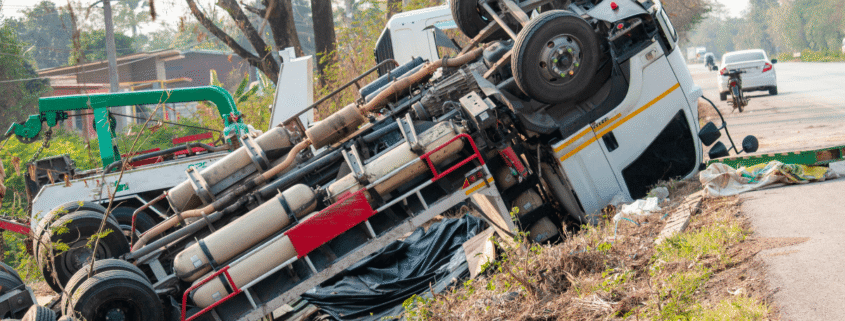
| Rollover | High center of gravity, speeding on curves, shifting cargo. | Can crush smaller vehicles and cause hazardous cargo spills. |
| Underride | Poor visibility, lack of guard maintenance, driver negligence. | Small vehicles slide beneath the trailer; often fatal. |
| Wide Turn | “Squeeze play” at intersections, driver inattention. | Smaller vehicles trapped in blind spots; causes side-impact injuries. |
| Rear-End | Distraction, tailgating, massive stopping distances. | Magnified impact force; causes spinal trauma and whiplash. |
| Lost Load | Improperly secured cargo, ignoring regulations. | Debris on road causes sudden swerving and chain-reaction crashes. |
| Head-On | Driver fatigue, intoxication, crossing the center line. | High-speed, catastrophic impact; often results in fatalities. |
What Are Frequent Causes of 18-Wheeler Accidents in Naperville, IL?
Truck accidents often stem from driver fatigue and poor training, where tight deadlines and lack of preparation compromise safety. Driving under the influence further impairs coordination, while overloaded cargo and inadequate maintenance create mechanical instability. By analyzing ELD data, training records, toxicology reports, and maintenance logs, investigators identify violations and corporate negligence to hold responsible parties accountable for these preventable collisions.
Driver Fatigue on the I-88 Corridor
Truckers hauling freight toward the I-88 and I-355 interchange often face intense pressure to beat “rush hour” gridlock. Fatigue is a major factor near the Route 59 commercial corridor, where exhausted drivers transitioning from long highway stretches to stop-and-go Naperville traffic suffer from delayed reactions. We scrutinize ELD data to see if drivers pushed past federal limits to reach local distribution hubs.
Poor Training in Suburbia
Navigating a semi-truck through tight turns near Downtown Naperville or the congested school zones along 75th Street requires specialized skill. Drivers who aren’t properly trained for “last-mile” suburban delivery are a hazard to local families. We examine training records to determine if a driver was ill-equipped for the unique geography of DuPage and Will Counties.
DUI & Accountability
Whether it’s a long-haul driver passing through or a local delivery, operating under the influence near landmarks like North Central College or the Naperville Riverwalk is a recipe for disaster. We partner with the Naperville Police Department and Illinois State Police to secure toxicology reports and hold impaired drivers fully accountable.
Overloaded Cargo on Local Arterials
An overweight truck traveling down Washington Street or Ogden Avenue requires significantly more stopping distance—a physics problem that turns deadly at busy intersections. Shifted cargo is especially dangerous on the winding stretches of 75th Street. We analyze weigh station data from nearby I-55 and shipping manifests to identify weight violations.
Inadequate Maintenance & Mechanical Failure
High-speed travel on the Ronald Reagan Memorial Tollway demands flawless equipment. A brake failure near the Naperville Road exit can trigger a catastrophic multi-car pileup. We investigate corporate inspection logs to see if a trucking company prioritized profits over fixing the tires or steering systems that failed on our local roads.
Common Injuries that Occur in Naperville Trucking Crashes
Victims of big rig accidents frequently suffer from:
- Traumatic Brain Injuries (TBI): Ranging from concussions to permanent cognitive impairment.
- Spinal Cord Injuries: Including partial or complete paralysis and chronic pain.
- Multiple Bone Fractures: Often requiring extensive surgery and rehabilitation.
- Internal Organ Damage: Life-threatening injuries to vital organs.
- Severe Burns: Resulting from fuel fires or chemical spills.
- Crush Injuries: Leading to amputation or major nerve damage.
Parties That May Be Responsible for a Naperville Truck Accident
- The Truck Driver: For violations of safety rules or distracted driving.
- The Trucking Company: For improper hiring or maintenance practices.
- Equipment Manufacturers: For defective components like brakes or tires.
- Cargo Loaders: For failing to properly secure or balance the trailer.
Protecting Your Rights in Naperville
At Fotopoulos Law Office, we believe in keeping our clients informed at every stage of the legal process. Attorney John S. Fotopoulos is prepared to stand up to trucking companies and their insurance carriers to ensure your rights are protected. We will fight for the damages you are entitled to under Illinois law.
Contact Our Naperville Truck Accident Lawyer
If you or a loved one has been hurt in a large truck crash, you do not have to face this situation alone. We are here to handle the legal aspects of your case, so you can focus on your recovery. Contact our office to get the help you need.
Call 708-942-8400 for a free consultation and case review today.
We serve clients in Naperville and the surrounding areas.
Naperville Truck Accident Frequently Asked Questions
1. Why are truck accidents in Naperville particularly dangerous compared to standard car crashes?
The primary reason for the extreme danger is the massive disparity in size and weight between commercial rigs and passenger vehicles. A fully loaded semi-truck can weigh up to 80,000 pounds and reach 70 feet in length. When these giants collide with smaller cars at highway speeds, the momentum generated is immense, often leading to catastrophic, life-altering injuries or wrongful death for those in the smaller vehicle involved.
2. Which specific areas in Naperville are considered high-risk zones for commercial truck collisions?
Naperville’s high-risk zones include the “Golden Corridor” of I-88, the Route 59 commercial stretch, and Ogden Avenue. The convergence of heavy freight traffic and dense suburban commuting creates dangerous bottlenecks. Specifically, intersections like Route 59 and North Aurora Road or 75th Street see high rates of “squeeze play” wide-turn accidents and T-bone collisions. These arterial roads were often not designed to handle the current extreme volume of commercial freight traffic.
3. How does the “Modified Comparative Negligence” rule impact my truck accident claim in Illinois?
Under Illinois statute 735 ILCS 5/2-1116, you can recover damages as long as you are not more than 50% at fault. However, your total compensation is reduced by your assigned percentage of responsibility. For instance, if you are awarded $100,000 but found 20% at fault for speeding, you will receive $80,000. If your fault exceeds 50%, state law bars you from recovering any financial compensation from the other parties.
4. What is the typical timeframe allowed for filing a truck accident lawsuit in Naperville?
Generally, the statute of limitations in Illinois provides a two-year window from the date of the accident or wrongful death to file a lawsuit. However, this timeline can be significantly shorter if the vehicle involved was owned by a government entity, such as a municipal maintenance truck. In those cases, the limit may be reduced to just one year. It is vital to consult a lawyer early to avoid missing these deadlines.
5. Can a trucking company be held liable for an accident caused by their driver’s error?
Yes, under the legal doctrine of “respondeat superior,” a trucking company is vicariously liable for a driver’s negligence if it occurred within the scope of employment. Furthermore, companies can face direct negligence claims for poor practices. This includes “Negligent Hiring” of drivers with reckless histories, “Negligent Retention” of those violating safety protocols, or “Negligent Maintenance” of the fleet. This allows victims to access the company’s higher insurance policy limits for recovery.
6. What is “spoliation of evidence” and why is it critical in truck accident litigation?
Spoliation refers to the intentional or negligent destruction of evidence. In truck accidents, crucial data like “Black Box” recordings and driver logs can be lost if not preserved quickly. Trucking companies often have internal policies to destroy data after specific periods. To prevent this, attorneys send “spoliation letters” immediately. This ensures that electronic evidence regarding speed, braking, and steering inputs is saved, providing an objective account of the moments preceding the crash.
7. What are the most common types of truck accidents handled by your Naperville legal team?
Our firm represents victims in a wide range of complex accidents. This includes “jackknife” incidents where the trailer swings dangerously, rollovers caused by shifting cargo, and fatal “underride” collisions where a car slides beneath a trailer. We also handle “squeeze play” wide-turn accidents at tight suburban intersections, rear-end collisions caused by massive stopping distances, and “lost load” accidents where unsecured cargo creates hazardous debris on local Naperville arterial roadways.
8. What specific types of financial compensation are available for truck accident victims?
Victims can pursue economic and non-economic damages. Economic damages cover quantifiable costs like hospital bills, future medical care, lost wages, and property damage. Non-economic damages compensate for “intangible” losses, including physical pain and suffering, emotional distress like PTSD, and permanent disfigurement. In cases of egregious misconduct, such as a company encouraging logbook falsification, a court may also award punitive damages to punish the defendant and deter similar future behavior.
9. Who are the potentially liable parties in a commercial vehicle accident claim?
Liability often extends beyond just the truck driver. While the driver is responsible for traffic violations and sobriety, the trucking company is responsible for training and maintenance. Additionally, equipment manufacturers can be held liable for defective brakes or tires that fail on the road. Finally, third-party cargo loaders may be responsible if they improperly secured or balanced the trailer’s weight, leading to a catastrophic rollover or a dangerous shifting load.