
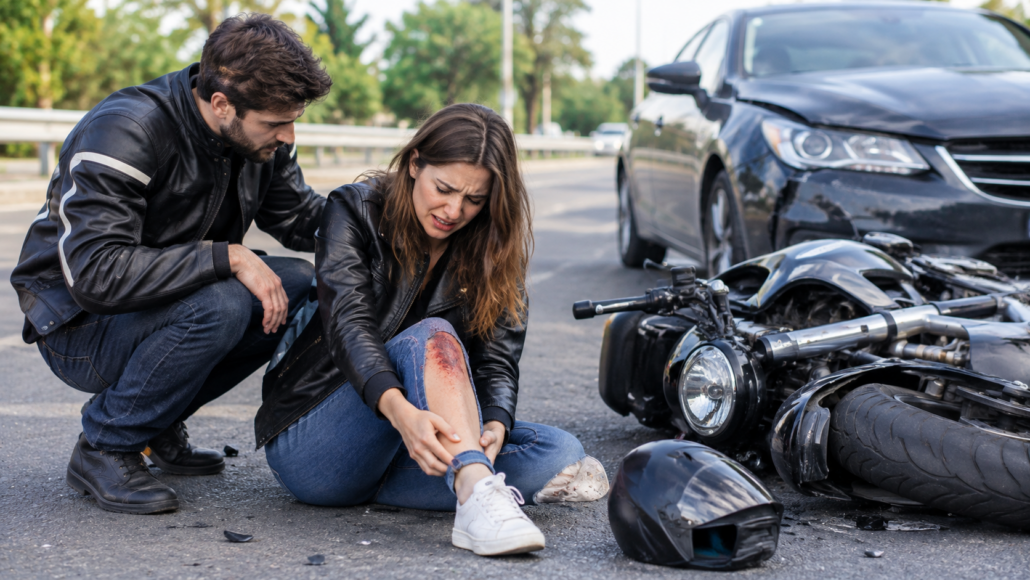
Can a Motorcycle Passenger Sue After a Crash?
Your friend was riding. You were on the back. Now there’s a cast on your wrist, a stack of hospital bills on the counter, and a question that feels almost disloyal to ask out loud: can you actually file a claim over this?
You can. Illinois allows a motorcycle passenger to sue after a crash, and a motorcycle passenger injury claim can be brought against the driver of another vehicle, the person operating the bike, or both. Because the passenger never touched the throttle, the brakes, or the handlebars, these claims often start from a stronger position than the operator’s own.
The guilt usually fades once people learn where the money comes from. Claims against an operator run through insurance purchased for exactly this risk, not through a friend’s or relative’s bank account.
Can a Motorcycle Passenger Sue the Driver They Were Riding with in Illinois?
Illinois allows an injured passenger to sue the operator of the motorcycle they rode on whenever careless riding caused the crash. The state’s guest statute, 625 ILCS 5/10-201, blocks only hitchhikers who solicited the ride from the roadway, and even a hitchhiker can recover if the operator acted willfully and wantonly.
Older versions of the Illinois guest law were far broader and shut out most nonpaying riders. Lawmakers narrowed the rule in 1971. Even so, outdated “guest” advice still makes the rounds in riding circles, and plenty of injured passengers assume they have no case. Someone who hopped on behind a friend outside a Pilsen taqueria faces no special barrier under the current guest statute, and neither does the girlfriend, son, or riding buddy of the person at the controls.
The passenger’s job is to prove ordinary negligence, meaning the operator failed to ride with reasonable care and that failure caused the injuries. Typical examples:
- Speed: riding well over the limit or weaving through traffic on the Kennedy Expressway
- Lane splitting: squeezing between stopped or slow-moving cars
- Impairment: riding after drinking or using cannabis
- Abrupt handling: braking hard or leaning aggressively with no warning to the passenger
- Inexperience: taking on a passenger without the skill to manage the added weight
Inexperience gets overlooked. Adding a second person changes how a motorcycle stops, corners, and balances at low speed, and an operator who has rarely ridden “two-up” can misjudge all three.
Who Else Can an Injured Motorcycle Passenger Hold Responsible?
Any party whose negligence contributed to the crash can face a passenger’s claim, including the driver of another vehicle, the motorcycle’s owner, a manufacturer of a defective part, or a government body responsible for a dangerous road. Under 735 ILCS 5/2-1117, a defendant found 25% or more at fault can be made to pay the full damages.
Fault is often shared. Suppose a driver turns left across a motorcycle’s path on Western Avenue while the operator is going 15 miles per hour over the limit. Both contributed, and the passenger can pursue both. Possible defendants include:
- Other motorists: the driver of a car, truck, delivery van, or rideshare vehicle
- The operator: the person riding the motorcycle the passenger was on
- The owner: someone who lent the bike to an operator they knew was unsafe (negligent entrustment)
- Manufacturers and sellers: makers of a defective tire, brake, or other component
- Bars and restaurants: an establishment that served alcohol to a driver who then caused the crash, under the Illinois Dram Shop Act
- Public entities: the body responsible for maintaining a dangerous road
One category of loss gets special treatment under Illinois’s joint liability statute. Every liable defendant shares responsibility for the passenger’s past and future medical expenses, however small that defendant’s share of fault. For a passenger whose bills from Northwestern Memorial Hospital or another trauma center make up most of the claim, that rule carries real weight. If alcohol played a part, move quickly. Dram shop claims carry their own statutory limits and timing rules.
What If a City Vehicle or Road Defect Caused the Crash?
Claims against the City of Chicago, Cook County, or another local public entity run on a shorter clock. Under 745 ILCS 10/8-101, a lawsuit against a local government entity or its employee generally must be filed within one year of the injury. Pothole and road-defect claims also face immunity defenses that private drivers cannot raise.
A pothole that a sedan rolls over without a second thought can throw a motorcycle. The passenger, with no handlebars to hold, tends to leave the seat first. Lower Wacker Drive, with its tight curves, dim lighting, and uneven pavement seams, is the kind of stretch where these claims arise.
To win, the passenger must show the public body knew or should have known about the hazard. Photos of the defect taken soon after the crash, 311 complaint records, and repair logs all help build that proof. A collision with a CTA bus or other transit vehicle may carry separate notice requirements, so pinning down the responsible agency early protects the claim.
Can a Passenger Sue a Spouse or Parent Who Was Driving the Motorcycle?
Generally, yes. In Cates v. Cates, the Illinois Supreme Court held that a parent’s negligent driving is not conduct protected by parent-child immunity, so a child injured as a passenger can bring a claim against a parent. The parent’s liability insurance pays these claims, not the family’s own savings.
The court’s reasoning was practical. Careful driving is a duty owed to everyone on the road, unlike discipline or household rules, which fall within a parent’s discretion. On a motorcycle, a parent who speeds or rides impaired puts the child behind them at the same risk as any stranger on the street. Spousal claims work much the same way. Illinois no longer bars one spouse from suing the other for injuries. If a wife is thrown from her husband’s bike on DuSable Lake Shore Drive, for example, she can generally pursue his liability coverage.
Where these cases get complicated is the policy itself. Some motorcycle policies include household or family-member exclusions that limit coverage for relatives living under the same roof. Reading the actual policy language early shows the family what coverage exists before anyone gives the insurer a statement.
Does Riding Without a Helmet Hurt a Passenger’s Injury Claim in Illinois?
Not automatically. Illinois has no universal motorcycle helmet law, so riding without one breaks no rule. Insurers may still argue that a helmet would have reduced a head injury, which can affect damages for that injury only. Federal safety data puts helmets at about 41% effective in preventing passenger deaths.
Illinois courts have not given insurers a clear green light on the helmet argument. When an adjuster raises it, the defense generally needs medical testimony showing a helmet would have changed the outcome, and that is harder to establish than a negotiation letter makes it sound. A fractured pelvis, a shattered ankle, or road rash down the length of an arm is untouched by the argument entirely.
Adjusters keep bringing it up for a reason, and the NTSB’s motorcycle safety findings show it: helmeted passengers survive crashes at markedly higher rates. Passengers who did wear a helmet should hold on to it, along with the jacket, gloves, and boots. Damaged gear shows the force of impact and where the body struck the pavement.
Can a Motorcycle Passenger Be Found Partly at Fault for a Crash?
It is possible, though uncommon, because the passenger controls neither the throttle nor the brakes. Under Illinois’s modified comparative fault rule in 735 ILCS 5/2-1116, a passenger’s award shrinks by their own share of fault, and a passenger found more than 50% responsible recovers nothing.
When insurers do argue passenger fault, the theories are predictable:
- Impaired operator: knowingly climbing on behind someone who was visibly drunk or high
- Sudden movement: shifting weight, leaning against a turn, or standing up at speed
- Distraction: grabbing the operator’s arms or pulling their attention away at a critical moment
- Wrong motorcycle: riding on a bike that was never built to carry two people
That final theory comes from the Illinois Vehicle Code. An operator may carry a passenger only on a motorcycle designed for more than one person, and both riders must sit astride the seat facing forward. A passenger perched sideways on a solo-seat sport bike gives the defense something to work with.
Some injury websites claim that a passenger who is half at fault recovers nothing, and that’s wrong. A passenger assigned exactly half the blame can still recover half of their damages, which in a serious injury case can mean a substantial sum.
Whose Insurance Pays a Motorcycle Passenger’s Medical Bills?
A motorcycle passenger’s medical bills are usually paid through liability insurance carried by whoever caused the crash, backed by uninsured and underinsured motorist coverage when that falls short. Illinois requires every auto liability policy to carry limits of at least $25,000 per person and $50,000 per accident for bodily injury.
In most cases, coverage comes into play in this order:
- The at-fault driver’s bodily injury liability policy, if another vehicle caused or contributed to the crash
- The motorcycle operator’s liability policy, when the operator’s riding played a role
- UM/UIM coverage on the motorcycle policy, when the at-fault driver has no insurance or too little
- The passenger’s own auto policy, which may extend UM/UIM protection even though the passenger wasn’t in a car
- Health insurance, Medicare, or Medicaid, which pays treatment bills up front and often seeks reimbursement later
Minimum limits run out fast. A single trauma admission at John H. Stroger Jr. Hospital of Cook County, followed by surgery and months of rehabilitation, can exhaust a minimum policy before the passenger is discharged. That’s where underinsured motorist coverage matters: as the Illinois Department of Insurance’s coverage definitions explain, it pays the difference between the injured person’s UIM limits and the at-fault driver’s liability limits.
What Compensation Can an Injured Motorcycle Passenger Recover?
Injured passengers can recover economic damages such as medical bills, lost wages, and reduced earning capacity, along with non-economic damages for pain, disfigurement, emotional distress, and loss of a normal life. Passengers are often thrown from the bike with almost no protection, so injuries tend to be severe and claim values rise accordingly.
The injuries themselves tend to follow a pattern:
- Traumatic brain injuries and concussions
- Road rash and degloving injuries that require skin grafts
- Pelvic, femur, and lower-leg fractures
- Spinal cord injuries and herniated discs
- Shoulder, elbow, and wrist injuries from bracing against the fall
A passenger rushed to the adult trauma center at UChicago Medicine on the South Side may spend weeks in inpatient care before rehabilitation even starts. Each of those days produces records, and that documentation is what turns an injury into a provable dollar figure. Illinois pattern jury instructions list loss of a normal life as its own element of damages, separate from pain and suffering, and it can be significant for passengers who can no longer ride, exercise, travel, or pick up their kids.
How Long Does a Motorcycle Passenger Have to File a Lawsuit in Illinois?
Most Illinois motorcycle passengers have two years from the crash date to file a personal injury lawsuit under 735 ILCS 5/13-202. A passenger who was under 18 at the time has two years from their 18th birthday under 735 ILCS 5/13-211. Missing the deadline usually ends the claim for good.
For a passenger who spends months in surgery and physical therapy, that window can close sooner than it seems. Evidence slips away too. Traffic camera and business security footage along corridors like Cicero Avenue is often overwritten within days or weeks, and the people who stopped to help are hard to find later. Negotiations don’t stop the clock. An insurer can trade offers for months, then go quiet once the deadline has passed, leaving the passenger with nothing to bargain with. A lawsuit filed on time keeps the claim alive while talks continue.
What Should a Motorcycle Passenger Do After a Chicago Crash?
Get medical care right away, even if pain seems minor, and make sure the Chicago Police Department or Illinois State Police documents the crash. Photograph the scene and injuries, collect witness contacts, keep damaged gear, and avoid giving a recorded statement to any insurer before speaking with a personal injury attorney.
In the days and weeks after the crash, a few habits protect the claim:
- Request the crash report. Crashes on expressways like the Eisenhower are generally handled by Illinois State Police, while city surface-street crashes go through the Chicago Police Department.
- Follow every treatment recommendation. Gaps in care give an insurer its favorite argument for paying less.
- Keep a short daily journal of pain, sleep, missed work, and activities you can no longer do.
- Save receipts for prescriptions, mobility aids, and travel to appointments.
- Go quiet on social media, or at the very least stop posting about the crash and your activities.
- Decline to sign medical authorizations sent by the other driver’s insurer.
- Notify your own auto insurer in writing, since many policies require prompt notice before a UM/UIM claim can proceed.
Plenty of passengers walk away from the scene feeling shaken but fine, because adrenaline hides pain. Concussion symptoms and internal injuries can take hours or days to surface. A same-day exam creates a medical record that ties the injury directly to the crash.
Where Are Chicago Motorcycle Passenger Lawsuits Filed?
Most Chicago motorcycle passenger lawsuits are filed in the Circuit Court of Cook County, with larger injury cases heard in the Law Division at the Richard J. Daley Center downtown. Crashes in DuPage or Will County are typically filed in those counties’ circuit courts. Most claims settle before reaching a jury.
Filing a complaint opens discovery. Attorneys can then take depositions, subpoena phone records, and obtain the operator’s riding and citation history. That pressure often pushes insurers toward realistic offers they would not have considered before suit.
Cook County civil cases frequently take well over a year to reach a trial date, and many resolve through mediation along the way. Venue depends on where the crash happened and where the defendants live, which can come into play for collisions near the county line in the southwest suburbs.
Talk With Fotopoulos Law Office About Your Motorcycle Passenger Injury Claim
You didn’t cause this crash, and you shouldn’t have to choose between paying your medical bills and keeping a relationship intact. Our attorneys handle passenger claims with both in mind. We track down every policy that may apply, deal with the insurers so you don’t have to, and build the evidence that shows what the crash has cost you.
From our Orland Park office, Fotopoulos Law Office represents injured passengers across Chicago, Cook County, and the southwest suburbs. Most personal injury attorneys work on a contingency fee basis, which means you don’t pay any attorney’s fees unless we win your case, and that is how we handle passenger claims. Call (708) 942-8400 to schedule a free consultation.
Frequently Asked Questions
1. Will the motorcycle operator have to pay out of pocket if i file a claim?
Usually not. A claim against an operator is paid by their liability insurer, which also hires and pays for their defense lawyer. Personal exposure generally becomes a concern only when damages far exceed the available coverage, and many of those cases still settle within policy limits.
2. Can I bring a claim after a single-vehicle motorcycle crash?
Yes. If the operator lost control because of speed, impairment, or poor judgment, the claim runs against the operator’s policy even though no other vehicle was involved. A defective part or a dangerous road surface can also support a claim when no one else was on the scene.
3. How do I get a copy of a Chicago police crash report?
Reports for crashes handled by the Chicago Police Department can be requested through the city once the report is finalized, which typically takes several days. Illinois State Police reports follow a separate request process. Your attorney can also obtain the report as part of the investigation.
4. Can my family file a claim if a motorcycle passenger was killed?
Yes. Illinois allows a wrongful death action, brought by the personal representative of the passenger’s estate on behalf of the surviving spouse and next of kin. The family may also pursue a survival claim for losses the passenger suffered before death. Deadlines for these claims differ from ordinary injury claims, so families should talk with an attorney promptly.
5. How long does a motorcycle passenger injury claim take to settle?
Claims with clear liability and completed medical treatment can settle within several months. Surgery, disputed fault, or multiple insurers usually stretch the timeline. Settling before treatment ends risks leaving future medical costs uncovered.
6. Will my health insurance company take part of my settlement?
Often, yes. Health insurers, Medicare, and Medicaid commonly hold reimbursement rights, called liens, for crash-related treatment they paid. These liens can frequently be negotiated down, which increases what the passenger actually takes home.







Leave a Reply
Want to join the discussion?Feel free to contribute!