
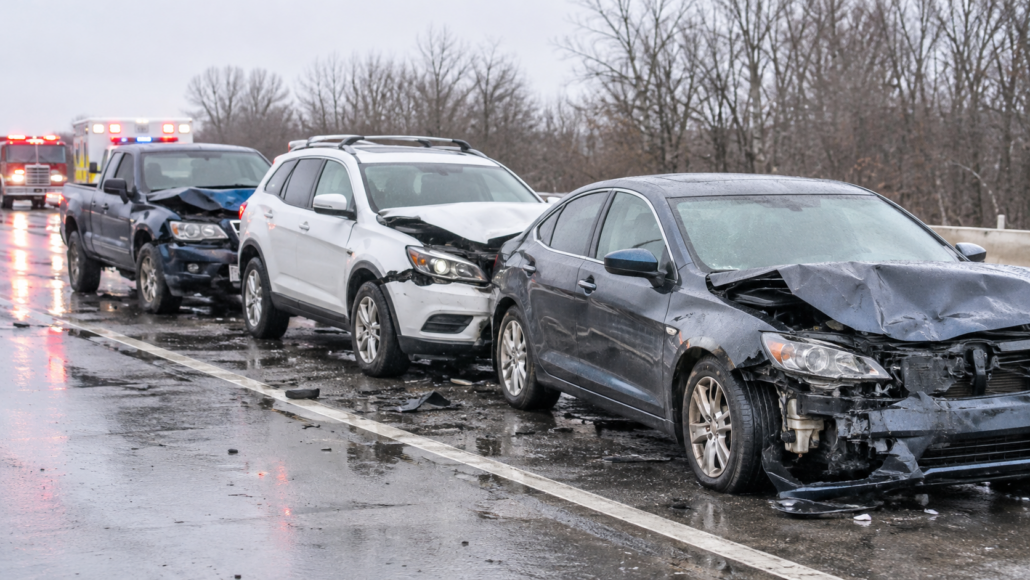
Who Is at Fault in a Multi-Car Pileup on an Illinois Highway?
Three insurance adjusters, three versions of the same crash, and each one ends with the blame landing somewhere else. That is the usual aftermath of a highway pileup. Illinois law does not force a single answer onto these collisions. Who is at fault in a multi-car pileup depends on the order of the impacts, what each driver could have done to stop, and how a jury splits responsibility among everyone involved. Two, three, or even four drivers can be held responsible for the same chain of wrecks on I-294 near Oak Lawn, each for a different piece of the harm.
How that blame gets divided controls which policies pay and how much of your loss you recover. Fotopoulos Law Office represents people hurt in highway collisions across the south and southwest suburbs, and we see firsthand how hard every insurer in a pileup works to make the problem someone else’s.
Who Is Usually at Fault in an Illinois Chain-Reaction Crash?
In most Illinois chain-reaction crashes, the driver who started the sequence by striking the vehicle ahead carries the largest share of fault. Under 625 ILCS 5/11-710, every driver must keep a following distance that is reasonable and prudent for speed, traffic, and road conditions, so a driver who couldn’t stop in time usually breached that duty.
Most of these crashes begin at the back of the line. Take a common pattern on the Stevenson Expressway at rush hour: a driver looks down at a phone, looks up too late, and hits a car that had already stopped. That car is shoved into the one ahead of it, and so on. Adjusters call those secondary hits push impacts, and the driver who started them typically answers for them.
Rear-ending another car doesn’t make a driver automatically liable in Illinois. The rear driver may be able to prove the car ahead cut in without room. Even so, a violation of the state’s following-distance rule can serve as evidence of negligence, and juries give that evidence real weight. Evidence that often points to a tailgating driver:
- Long skid marks ending right at the point of impact
- Heavy front-end crush damage on the striking car, with lighter damage on the vehicles it pushed
- Dashcam or traffic camera footage showing a short gap before the first collision
- Phone records showing activity at the moment of the crash
Can Several Drivers Share the Blame for the Same Pileup?
Yes. Illinois juries assign each driver a percentage of fault, and an injured person can still recover as long as their own share is 50% or less under 735 ILCS 5/2-1116. Any award shrinks by that percentage, so a driver found 20% at fault collects 80% of the damages.
A jury doesn’t sort out fault two cars at a time. It weighs everyone whose conduct played a part in your injury, sometimes including you, and the percentages must total 100. Illinois’s comparative fault statute works the same way whether two cars collided or twenty.
Insurers understand the arithmetic well, and their first instinct is often to move percentage points onto the person who got hurt. Arguments commonly aimed at victims include:
- Checking a phone or navigation screen in the seconds before impact
- Driving faster than surrounding traffic as the slowdown formed
- Making a late lane change into a lane that was already braking
- Driving with burned-out brake lights or badly worn tires
Some fault on your part lowers a claim. It only defeats the claim if your share crosses the statutory line, and solid evidence gathered early can push those percentages back down.
If Several Drivers Caused My Injuries, Which One Has to Pay?
Under 735 ILCS 5/2-1117, every liable defendant owes the full amount of your medical expenses. For other damages, a defendant found 25% or more at fault can be made to pay the entire remaining award, while a defendant under 25% pays only its own percentage share.
This rule protects injured people when one wrongdoer can’t cover the loss, a situation pileups produce again and again. Consider a hypothetical:
- A jury finds Driver A 60% at fault, Driver B 30%, and Driver C 10%.
- Driver A has only a minimum policy, which covers a fraction of your lost wages and pain and suffering.
- Driver B sits above the threshold, so B’s insurer can be required to make up that shortfall, while Driver C owes only a 10% share of those non-medical damages.
That shortfall is exactly what the joint and several liability statute was written to address. It is also why so much of a multi-defendant case turns on the allocation itself, since a few percentage points can move a well-insured defendant from one side of the line to the other.
Is the Driver Who Started the Pileup Responsible for Every Car Behind?
Not always. The first careless driver may be responsible for the opening collision, but each driver behind still had an independent duty to stop safely. When a pileup is really a series of separate crashes, fault is assigned impact by impact rather than placed entirely on one driver.
Investigators draw a line between a single chain reaction, where one blow sends cars into each other like dominoes, and a series of separate collisions, where the first wreck stops traffic and later drivers can’t stop in time. A driver who slammed into the stopped line thirty seconds later had time to react and didn’t use it. Stop-and-go waves like these build regularly at merge points on I-80 near Tinley Park and near the I-55 and I-80 interchange in Channahon.
Where a car sat in the line raises different questions:
- The lead driver can carry fault for brake-checking, cutting across lanes without room, or stopping suddenly for no traffic reason.
- A middle driver may share fault if they struck the car ahead on their own before being hit from behind, something damage to both bumpers often reveals.
- The last driver usually faces the toughest questions, because nothing behind them affected their ability to stop.
Can Fog, Snow, or a Dust Storm Excuse Drivers in a Pileup?
Rarely. Under 625 ILCS 5/11-601, Illinois drivers must keep their speed reasonable for actual conditions and slow down as needed to avoid colliding with anyone on the road. Poor visibility usually raises the standard of care rather than excusing a driver who kept going too fast.
Central Illinois saw what low visibility can do on May 1, 2023. Wind lifted topsoil off plowed fields and blinded drivers on I-55 in Montgomery County, south of Springfield. More than 70 vehicles, semi-trucks among them, piled into one another near mile post 76. Seven people were killed and more than 30 were hurt.
Weather accounts for why the road became dangerous. It doesn’t account for why a particular driver kept rolling at highway speed into a wall of dust, fog, or snow. When drivers can’t see ahead, the state’s basic speed law generally expects them to slow sharply, leave more room, or pull off the road. Some defendants raise a sudden emergency argument, claiming they faced an unexpected danger and reacted reasonably. It tends to fall flat when the driver helped create the danger or should have seen it coming, as with a snow squall visible ahead on a Chicago-area expressway.
What Changes When a Semi-Truck Is Involved in the Pileup?
Truck drivers face stricter federal rules. Under 49 CFR 392.14, commercial drivers must use extreme caution and reduce speed in fog, snow, rain, dust, or smoke, and stop driving entirely if conditions become too dangerous. The trucking company may also share liability for the driver’s conduct, training, or hours.
A loaded tractor-trailer needs far more room to stop than a passenger car. Because of the federal hazardous-conditions regulation, a trucker who drove into fog or a whiteout at cruising speed may have broken a specific safety rule, not just the general duty to drive carefully.
Trucks also bring more defendants. The motor carrier is generally responsible for its driver’s negligence on the job and can face separate claims for negligent hiring, training, or supervision. Freight routes like I-55 near Joliet and I-80 near Morris carry a constant stream of big rigs, and carriers usually hold much larger policies than individual drivers. Key truck evidence includes:
- Electronic logging device (ELD) records showing hours on duty
- Engine control module (ECM) data capturing speed and braking before impact
- Dispatch messages that may show pressure to keep moving despite the weather
- Maintenance records for brakes and tires
Can a Government Agency or Road Contractor Share Fault for a Pileup?
Sometimes. A poorly marked work zone, a missing warning sign, or a malfunctioning signal can contribute to a highway pileup. Claims against local public entities in Illinois generally must be filed within one year under 745 ILCS 10/8-101, much shorter than the standard two-year deadline for most injury claims.
Road work on the Tri-State Tollway and the Stevenson funnels traffic into narrow lanes and causes sudden backups where lanes taper. A contractor that skimps on advance warning signs or leaves equipment in a travel lane can share responsibility for the pileup that follows, just like any other negligent party.
Government defendants play by different rules. A village, county, or township that maintains a road holds certain immunities under the Local Governmental and Governmental Employees Tort Immunity Act. Claims involving roads maintained by IDOT or the Illinois Tollway generally follow a separate process outside the circuit courts. Either way, speed matters, since temporary signs and barrels vanish once a work zone moves.
How Do Investigators Decide Which Impact Caused Which Injury?
Investigators break a pileup into individual impacts using crush damage, debris fields, vehicle resting positions, event data recorder downloads, dashcam footage, and witness accounts. Accident reconstruction experts then match each impact to the injuries it caused, which matters most when several drivers struck the same vehicle.
Crashes on interstates and tollways are typically handled by Illinois State Police, while local departments such as the Palos Heights and Orland Park police respond on surface streets. The crash report is where the analysis starts, not where it ends. Officers often arrive after the cars have moved, and a report listing five vehicles may never say which one hit yours first or hardest.
Your medical records feed into this too. When doctors note that one impact from behind whipped your neck and a second drove your knee into the dashboard, those notes help connect each injury to the driver responsible. Pileup lawsuits from Palos Heights, Oak Lawn, and the Cook County part of Orland Park that seek more than $100,000 are among the Law Division tort cases heard at the Bridgeview Courthouse.
Whose Insurance Pays After a Multi-Car Pileup in Illinois?
Illinois is an at-fault state, so each negligent driver’s liability insurer pays its share of the harm. Minimum Illinois policies cover only $25,000 per person and $50,000 per accident for bodily injury, which a handful of injured people can exhaust quickly. Your own underinsured motorist coverage can help fill that gap.
Those limits get divided in a pileup. When three people are hurt by a driver with a minimum policy, the per-accident cap has to cover all three. Illinois also has no personal injury protection (PIP) requirement, so no no-fault benefit steps in to pay your bills regardless of who caused the crash. Under rules overseen by the Illinois Department of Insurance, underinsured coverage comes with any policy carrying uninsured motorist limits above the state minimum. A quick look at your own declarations page tells you whether that backup layer is there.
What Should You Do If You Were Hit More Than Once in a Pileup?
Get medical care the same day and describe every impact to your providers, since multiple hits often cause multiple injuries. After that, the priorities are evidence and caution: preserve proof of each vehicle’s role, identify every driver and insurer involved, and say little to adjusters until an attorney reviews your claim.
A pileup leaves loose ends that a two-car crash doesn’t. Over the next several days:
- Count the hits. Write down how many impacts you felt, which direction each came from, and how much time passed between them.
- Get the report number from Illinois State Police or the local department that responded.
- Save video quickly. Ask nearby businesses for footage and copy your own dashcam files before they are recorded over.
- Keep up with follow-up care. Return visits at places like Northwestern Medicine Palos Hospital or Morris Hospital build a continuous record, and gaps in treatment hand insurers an argument.
- Hold off on signing any release. Settling with one driver’s insurer on the wrong terms can wipe out claims against the others.
Talk With Fotopoulos Law Office About Your Pileup Claim
One pileup can mean several claims at once, against drivers and insurers who all want a smaller slice of the blame. Fotopoulos Law Office represents people injured in multi-vehicle crashes in Palos Heights, Orland Park, Oak Lawn, Morris, and communities throughout Illinois. We gather the evidence that untangles each impact, track down every available policy, and push back when an insurer tries to pin the fault on you.
Most personal injury attorneys work on a contingency fee basis, which means you don’t pay any attorney’s fees unless we win your case. We handle pileup claims the same way, and your first consultation is free. Call 708-942-8400 to tell our legal team what happened.
Frequently Asked Questions
1. Does a traffic ticket decide who is at fault in my civil claim?
No. A citation reflects an officer’s judgment at the scene, and the civil case is decided separately on all of the evidence. A ticket, or a guilty plea to one, can still become part of that evidence, so talk with a lawyer before paying a citation written after a serious crash.
2. What if the driver who started the pileup drove away?
A hit-and-run driver doesn’t leave you without options. Uninsured motorist coverage on your own policy generally applies when the responsible driver can’t be identified, and the other drivers may still carry their own share of fault. Report the departing vehicle to police promptly and keep any description, partial plate, or video of it.
3. I was a passenger in the pileup. Whose insurance covers me?
Passengers are rarely at fault, which tends to make their claims more straightforward. You may be able to claim against the driver of your car, any other driver who contributed to the crash, and, if those limits run short, coverage under a policy in your own household.
4. Can a family member file a claim if someone was killed in a pileup?
Yes. Illinois allows a wrongful death action, brought by the personal representative of the person’s estate, for the benefit of the surviving spouse and next of kin. The same fault-sharing rules apply, so every driver who contributed to the fatal impact can be part of the case.
5. How long does a multi-car pileup claim take to resolve?
Usually longer than a two-vehicle claim. Several insurers, a disputed sequence of impacts, and competing claims against limited policies all add time. Simpler pileup claims can wrap up within months, while contested cases with several defendants may take a year or more.








Leave a Reply
Want to join the discussion?Feel free to contribute!