
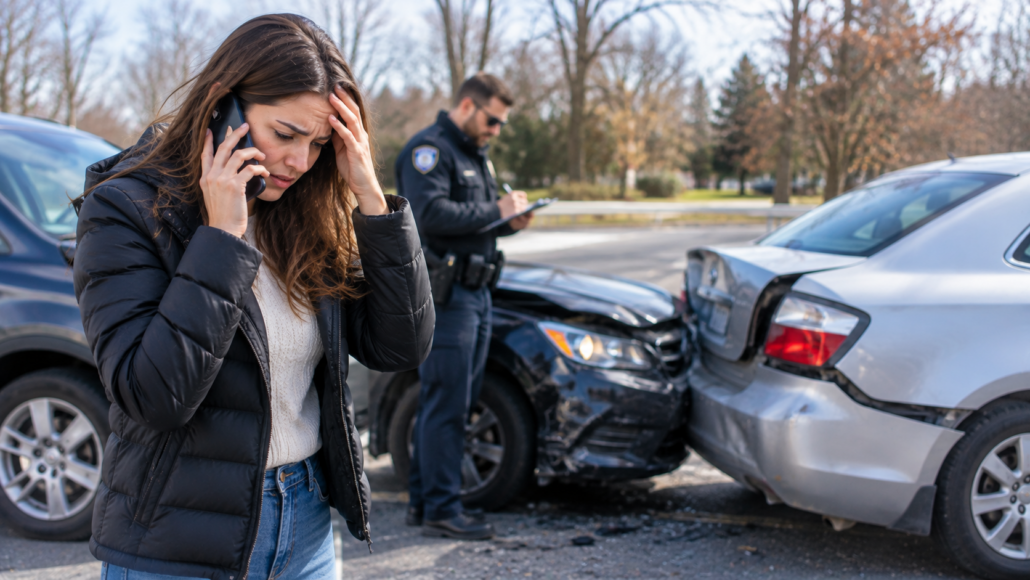
Orland Park High-Speed Collision Lawyers
Speed is the one detail of a crash that a careless driver cannot talk away once someone has measured it. Our Orland Park high-speed collision lawyers focus on getting that measurement right, then building a claim that accounts for everything the crash took from you.
A fast-moving crash also changes who is paying attention. Injuries tend to run deeper, and prosecutors may get involved. Insurers notice too, and they dig in early because a high-speed crash usually means a large claim. Fotopoulos Law Office represents injured people across Orland Park and the southwest suburbs. A former Cook County Circuit Court judge leads our firm, and that time on the bench gives our team a judge’s view of how this kind of evidence gets weighed.
What Counts as a High-Speed Collision Under Illinois Law?
A high-speed collision in Illinois is any crash where a driver went faster than was reasonable for traffic, weather, or road conditions, not only faster than the posted sign. Under 625 ILCS 5/11-601, a motorist driving at or below the limit can still be negligent for failing to slow near intersections, curves, or congestion.
A posted limit sets a ceiling. It does not create a safe harbor. The reasonable-speed statute also requires drivers to slow down for special hazards, and that duty holds even when the speedometer reads 44 in a 45 zone.
Where no sign is posted, Illinois falls back on default limits: 30 mph in urban districts, 55 mph on most other roads, 65 mph on qualifying four-lane divided highways, and 70 mph on interstates such as I-80. Around Orland Park, speed-related crashes tend to follow a handful of patterns:
- Interstate-to-arterial transitions: Drivers leaving I-80 at LaGrange Road sometimes carry highway speed onto a corridor lined with traffic signals and turning shoppers.
- Retail congestion: Stop-and-go traffic near Orland Square Mall leaves little margin for a driver who approaches a backup too fast.
- Weather: The first snow or freezing rain of the season can make a normal speed unreasonable, and Illinois law expects drivers to adjust.
- Signal timing: Drivers who speed up to beat a yellow light create the conditions for right-angle, or T-bone, crashes.
Does a Speeding Ticket Prove the Other Driver Was at Fault?
A speeding ticket supports your claim but does not decide it. Driving 26 to 34 mph over the limit is a Class B misdemeanor under 625 ILCS 5/11-601.5, and 35 mph or more over is a Class A misdemeanor. Reckless driving under 625 ILCS 5/11-503 covers willful or wanton disregard for safety.
On its own, an ordinary speeding ticket rarely carries much weight in a civil courtroom. Extreme speed is different. The excessive speeding law turns what most people think of as a traffic ticket into a criminal case, and an insurance adjuster reads that charge as a sign the claim will be hard to defend.
The two cases also run on different standards. A civil claim needs only a preponderance of the evidence, a lower bar than proof beyond a reasonable doubt, so a driver who beats the criminal charge can still owe you compensation. Pay attention to how the ticket is resolved. A guilty plea can often be used as evidence in the civil case, which is why we follow the traffic or criminal file from the first court date.
At the top of the scale sits the reckless driving law, which makes the offense a felony when the crash causes great bodily harm or permanent disability. An aggravated reckless driving charge often reflects the kind of conduct that later supports punitive damages.
How Do Investigators Prove How Fast a Driver Was Going?
Investigators prove speed through physical and digital evidence rather than witness guesses. Event data recorders store pre-crash speed and braking, accident reconstruction specialists analyze crush damage and tire marks, and traffic or business cameras can time a vehicle between fixed points. Police crash reports and dispatch records fill in the remaining timeline.
Eyewitnesses rarely judge speed well in the instant before an impact. The harder problem is that the most reliable speed evidence is also the most fragile:
- Video overwrites: Many business and traffic camera systems record over themselves within days or weeks, so footage from storefronts along LaGrange Road or 143rd Street has to be requested right away.
- Salvage auctions: Once an insurer declares a car a total loss, it can be sold and shipped out of state, taking its crash data with it.
- Road evidence: Tire marks fade under traffic and weather, and debris is swept up the same day, so photographs and survey measurements need to happen early.
- Telematics data: Fleet trackers and app-based driving logs may be deleted on a routine schedule unless someone formally asks the company to keep them.
That is why a preservation letter goes out early to the at-fault driver, the insurers, and any business with cameras. Once they are on notice, losing the evidence can create serious problems for whoever let it go.
Officers from the Orland Park Police Department, or the Illinois State Police on I-80, sometimes estimate speed at the scene, and those estimates make a useful starting point. An accident reconstruction expert witness takes the analysis further, showing a jury how many feet the other driver needed to stop and how many were actually available.
Why Are High-Speed Crash Injuries So Severe?
Speed multiplies the force a body absorbs in a crash and shortens the time anyone has to react. NHTSA reports that speeding contributed to 29% of all U.S. traffic deaths in 2024, and that higher speeds lengthen stopping distances and reduce how well seat belts and airbags protect occupants.
The physics are unforgiving. Crash energy rises with the square of speed, so doubling a vehicle’s speed roughly quadruples the energy released in a sudden stop. Whatever crumple zones and restraints cannot absorb, the human body does.
Speed also makes a crash more likely in the first place. Federal traffic safety research links speeding to loss of vehicle control, which helps explain why so many speed-related crashes involve rollovers or vehicles leaving the road. Injury patterns tend to follow the type of crash:
- Rear-end impacts: At high speed, these go well beyond a typical neck strain and can cause disc herniations and fractured vertebrae.
- Side-impact crashes: Doors offer little crush space, so occupants on the struck side often suffer pelvic fractures, broken ribs, and internal organ injuries.
- Rollovers: Roof crush and partial ejection lead to head, neck, and spinal cord injuries.
- Underride crashes: When a speeding car strikes the back or side of a semi-trailer on I-80, the passenger compartment can slide beneath the trailer, causing devastating head trauma.
Orland Park residents with serious injuries often go to Northwestern Medicine Palos Hospital, and the most severe trauma cases go to the Level I trauma center at Advocate Christ Medical Center in Oak Lawn. Months of rehabilitation frequently follow, so we approach these as catastrophic injury cases from day one.
Who Can Be Held Responsible for a High-Speed Crash in Orland Park?
The speeding driver is the primary defendant, but responsibility often reaches further. An employer may answer for a worker speeding in a company vehicle, a racing partner may share fault, and a government body may be involved when a police pursuit or a known road defect contributed to the crash.
For an employer, the question is whether the driver was acting within the scope of employment. A service call usually qualifies; a late-night drive home from a bar usually does not. If respondeat superior applies, the employer’s commercial auto policy comes into play, and it is often far larger than a personal one.
Government defendants play by different rules. The Local Governmental and Governmental Employees Tort Immunity Act gives villages, counties, and police departments defenses that a private driver never gets to raise.
What Happens When Several Drivers Share the Blame?
Illinois splits liability by percentage of fault in multi-vehicle crashes. Under 735 ILCS 5/2-1117, every liable defendant answers in full for your medical expenses, while a defendant at 25% fault or more is responsible for all other damages and one below 25% pays only its own share.
Consider a hypothetical rush-hour pileup on LaGrange Road: one speeding driver, several damaged vehicles, and an insurer for each one pointing somewhere else. The joint liability statute decides whether you can collect your full judgment from the defendant whose insurance can actually pay.
Small shifts carry real weight here. Moving even a few percentage points of fault onto a well-insured defendant can change how much of a judgment you actually collect. A commercial truck in the chain adds federal safety rules and larger policies to the picture.
Can I Still Recover Compensation If I Was Also Speeding?
Yes, as long as your share of fault is 50% or less. Illinois follows modified comparative negligence under 735 ILCS 5/2-1116, so a jury reduces your award by your percentage of fault. A driver going a few miles over the limit rarely carries the same blame as one traveling far above it.
Expect the other side to pull your car’s event data recorder, too. If it shows 49 in a 45 zone, the adjuster will argue you share the blame. Illinois’s comparative fault rule permits that argument, but it does not treat every mile per hour the same.
Causation matters more than rule-breaking. A driver slightly over the limit who had no chance to avoid a car blowing through a red light did not cause that crash in any meaningful way. Fault usually gets divided by looking at:
- Relative speed: How far each driver was above the limit and above the flow of traffic.
- Sight lines: Whether each driver had a clear view in time to react.
- Right of way: Signal phase, stop signs, and lane position at the moment of impact.
- Avoidability: Whether the crash would have happened at the exact posted limit.
Avoidability often settles the question, and reconstruction work can show the crash would have happened regardless of your speed.
What Compensation Is Available After a High-Speed Collision?
Victims of high-speed crashes in Illinois can pursue economic damages such as medical bills, lost wages, reduced earning capacity, and vehicle loss, plus non-economic damages for pain, disability, disfigurement, and loss of normal life. Catastrophic injuries often require life-care planning to value future treatment accurately.
In these cases, future losses often dwarf past ones. Care for a spinal cord injury can stretch across decades of attendant care, home modifications, and replacement equipment. An economist then converts those costs to present value so a jury can award a fair sum today.
Lost earning capacity is measured in a similar way. A vocational expert looks at whether you can return to your old job, a lower-paying one, or none at all, then calculates the gap over a working lifetime. The strongest damages claims are built on records like these:
- Billing and lien records from every provider, including ambulance and rehabilitation services.
- Wage statements and tax returns documenting income before the crash.
- Treating physician narratives describing permanent restrictions.
- A daily journal recording pain, sleep disruption, and missed activities.
When Are Punitive Damages Available?
Punitive damages may be available when a driver’s conduct was willful and wanton, such as racing or traveling at extreme speeds through traffic. Illinois bars requesting them in the original complaint; under 735 ILCS 5/2-604.1, the injured person must later ask the court for permission and show a reasonable likelihood of proving supporting facts.
Illinois pattern jury instructions describe willful and wanton conduct as a course of action showing utter indifference to, or conscious disregard for, the safety of others. Doing 90 through a residential neighborhood or weaving through rush-hour traffic can meet that bar. A momentary lapse in attention will not.
Timing is where these requests go wrong. The punitive damages statute requires the request no later than 30 days after discovery closes, so we document the driver’s conduct throughout the case instead of waiting for trial. Punitive awards may not be covered by insurance, which can bring the at-fault driver’s personal assets into play.
What If the Speeding Driver’s Insurance Won’t Cover My Losses?
Illinois only requires drivers to carry $25,000 per person and $50,000 per accident in bodily injury liability, which a single high-speed crash can exhaust quickly. When the at-fault policy runs out, underinsured motorist coverage on your own policy, umbrella policies, and employer coverage may provide additional recovery.
Minimum limits disappear quickly. A week in the hospital can push medical bills past a minimum policy before anyone tallies lost wages, and when several people are hurt in one crash, they all draw from the same per-accident limit.
Your own policy usually comes next. State insurance rules require uninsured motorist coverage on every policy, but underinsured motorist coverage exists only if you bought uninsured limits above the state minimum. Plenty of drivers learn what they actually purchased only after a crash.
We also look at:
- Household policies that cover resident relatives living with you.
- Medical payments coverage on your auto policy, which can pay treatment costs regardless of fault.
- Liquor liability coverage when a speeding driver was also drunk and had been overserved at a bar or restaurant.
Where Will My Case Be Filed, and How Long Do I Have?
Most Orland Park crash lawsuits are filed in the Circuit Court of Cook County, with the village’s small Will County portion falling under the Twelfth Judicial Circuit in Joliet. Illinois generally allows two years to file under 735 ILCS 5/13-202, but claims against a local public entity carry a one-year deadline under 745 ILCS 10/8-101.
Within Cook County, Orland Park cases are typically heard at the Fifth Municipal District courthouse in Bridgeview, although larger claims may proceed in the Law Division. Pinpointing where the crash happened matters, since a collision a few blocks across the county line belongs in a different courthouse with its own local rules.
Two years can slip by quickly. Serious injuries often take months to stabilize, and a late filing ends the claim no matter how strong it is. The shorter public-entity deadline surprises a lot of people. It can come into play when a village police vehicle, a county truck, or a road maintenance problem contributed to the crash, and the clock keeps running while you are still in treatment.
How Much Does It Cost to Hire Our High-Speed Collision Lawyers?
Your first meeting with our Orland Park legal team costs nothing, and there is no obligation to hire us. During the free consultation, we review the crash, your injuries, and the insurance involved, then explain our fee arrangement in writing before any work begins.
We talk about money plainly so you can decide without pressure. Case expenses such as reconstruction work, vehicle data downloads, and medical record fees are part of that conversation, including who advances them and how they are handled when the case ends.
Contact Our Orland Park High-Speed Collision Lawyers
Speed evidence starts slipping away soon after a crash, so the sooner we begin, the more we can preserve. Fotopoulos Law Office represents injured people and families from our office at 14496 John Humphrey Drive, serving Orland Park, Tinley Park, Orland Hills, Palos Heights, Mokena, and nearby communities. Call (708) 942-8400 to set up your free consultation. Our attorneys will listen to what happened, explain your options under Illinois law, and give you an honest assessment of how we can help.
Frequently Asked Questions
1. I was a passenger in the speeding car. Can I file a claim?
Yes. A passenger can bring a claim against the driver of the car they were riding in, and that driver’s liability insurance responds just as it would for anyone else. When another driver also played a part, both claims can move forward together.
2. Does not wearing a seat belt hurt my injury case in Illinois?
Generally, no. Under 625 ILCS 5/12-603.1(c), failing to wear a seat belt cannot be treated as evidence of negligence and cannot reduce your recovery. Insurers occasionally raise it anyway, and we push back when they do.
3. What if the speeding driver was fleeing police?
The fleeing driver remains responsible for the crash and is the first target of any claim. Holding the police department responsible is harder, because Illinois gives officers significant protection during pursuits. These cases need prompt review, since the deadline for claims against public bodies is short.
4. What if the speeding driver left the scene?
You still have options after a hit-and-run. If the driver is never found, your own uninsured motorist coverage can often pay for your injuries. Report the crash to police promptly and tell your insurer quickly, since many policies set their own notice requirements.
5. Do I have a claim if the speeding driver never hit my car?
Possibly. A speeding driver who forced you off the road or into another vehicle can still be responsible without any contact. These claims depend heavily on witnesses or video, and insurance policies may impose specific conditions when the driver who caused the crash is never identified.
6. What if a high-speed crash killed my family member?
Illinois allows a wrongful death claim, brought through the personal representative of the estate on behalf of the surviving family. It can recover losses such as the companionship and financial support the family relied on.







Leave a Reply
Want to join the discussion?Feel free to contribute!