
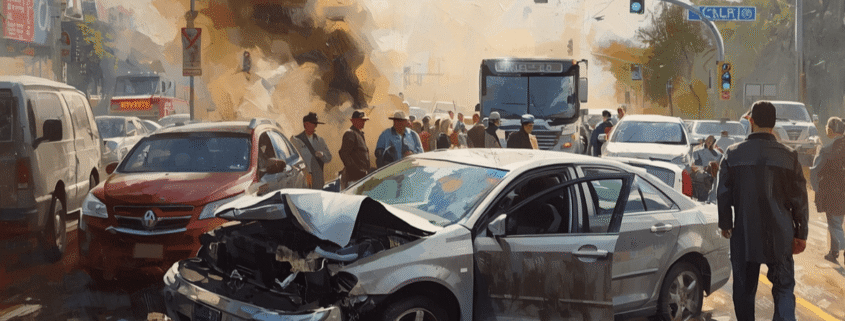
Morris, IL Car Accident Lawyer | Fotopoulos Law Office
Three places in Morris account for most of the serious car crashes our firm sees: the I-80 ramps at Exit 105, the Route 47 bridge across the Illinois River, and the downtown grid where Liberty Street meets Main and Washington. Each one produces a recognizably different kind of case, with a different mix of fault arguments from the insurance company on the other side. Fotopoulos Law Office represents drivers and passengers hurt in any of them. Attorney John Fotopoulos, who previously served as a Cook County Circuit Court Judge, leads our legal team. Call (708) 942-8400 for a free, no-obligation consultation.
Where do most Morris car accidents happen?
Morris car accidents cluster along three identifiable corridors. I-80 Exit 105 — the Route 47 interchange — concentrates highway-to-arterial transition crashes. Illinois Route 47 itself, including the Illinois River bridge, carries heavy north-south commuter traffic between Morris and Joliet. And the Liberty Street and Main Street downtown grid produces lower-speed but frequent intersection and pedestrian-vehicle crashes.
I-80 Exit 105 is the city’s primary highway access point. Drivers transitioning between interstate speeds and arterial traffic produce a steady volume of merge-related and rear-end collisions, especially during construction and severe weather. The freight component matters here: I-80 truck traffic feeding regional logistics generates a consistent share of commercial vehicle crashes near the exit, which is why a Morris case can quickly turn into something larger when the at-fault vehicle turns out to be an interstate semi.
Illinois Route 47 runs north-south through Morris and connects the city to Yorkville to the north and Joliet to the east. The Route 47 bridge across the Illinois River is a recurring backup point and a known crash zone, particularly in winter when ice and reduced visibility combine with commuter volume. Within city limits, Route 47 / Main Street and Route 47 / US Route 6 are recurring intersection-crash locations.
The downtown grid — Liberty Street, Main Street, Washington Street, and Illinois Avenue — produces a different fingerprint. Lower speeds, but pedestrian density from the historic downtown and parking turnover at downtown businesses concentrate intersection and pedestrian-vehicle incidents. Morris’s above-average severe weather history adds another layer: multi-vehicle pile-ups on I-80 during storms are not rare, and weather alone is rarely a defense to fault.
Why do insurance company arguments look different on Route 47 than on I-80?
The legal standard is the same across every corridor: Illinois follows modified comparative negligence under 735 ILCS 5/2-1116, which reduces a recovery in proportion to the injured driver’s share of fault and bars any recovery at 51% or more. What changes from corridor to corridor is the playbook insurers use to push that percentage past the line.
On I-80, fault arguments tend to focus on speed and following distance. The interstate is a high-speed environment, and adjusters routinely argue that an injured driver was traveling too fast for conditions, was following too closely, or failed to react to a slowing line of traffic. In construction zones — frequent on the I-80 stretch through Grundy County — the argument shifts to whether the injured driver was paying enough attention to posted warnings. Documenting the actual conditions at the moment of impact is what counters this. Crash data, traffic-camera footage, and witness statements from other drivers in the corridor matter more than they would in a quieter case.
On the Route 47 bridge across the Illinois River, the fault arguments shift to weather and surface conditions. In winter, insurers commonly argue that ice on the bridge made a crash inevitable and unavoidable for everyone involved to spread fault thinly across multiple drivers rather than concentrate it on the one most responsible. The defense is documenting that other drivers were navigating the same conditions safely. Pictures, dashcam, and eyewitness accounts establish that the at-fault driver did something different, not just that the bridge was slick.
Downtown intersection crashes draw a third pattern. At Liberty/Main, Liberty/Washington, and the four-way stops scattered through the historic district, adjusters lean on right-of-way arguments and on whether pedestrians were in marked crosswalks. Surveillance video from downtown businesses often resolves these cases one way or the other, but the footage cycles fast — typically within thirty days — which is one of several reasons a Morris car accident lawyer’s first move is usually a preservation letter to nearby businesses. Illinois’s two-year filing deadline under 735 ILCS 5/13-202 is the formal deadline, but the practical evidence deadline is much shorter.
What does Morris Hospital being downgraded mean for your car accident case?
Morris Hospital ended its Level II Trauma Center designation in 2025. The hospital still has a 24/7 emergency department at 150 W. High Street, full Primary Stroke Certification, and an Emergency Department Approved for Pediatrics. What it no longer has is an on-call trauma surgeon. Severely injured Morris crash victims are now stabilized at Morris Hospital and transferred to Silver Cross Hospital in New Lenox, Advocate Christ Medical Center in Oak Lawn, or Loyola University Medical Center in Maywood.
For most car accident cases — contained injuries, no surgery, treatment that begins and ends locally — nothing about this changes. The injured driver goes to Morris Hospital, gets evaluated, and follows up with a primary care physician or other treating provider. The case is built on a single set of records, and the medical timeline reads cleanly.
In a serious case the picture is different. The Morris Hospital emergency department record will document the initial presentation — vital signs at intake, imaging studies, the decision to transfer. The receiving trauma center’s record will document the surgery, the inpatient course, and the discharge planning. A rehabilitation provider may add a third record. Each institution bills separately, each generates its own discharge summary, and each holds pieces of the timeline that the other facilities don’t. Insurance adjusters look closely at gaps between these records and at any inconsistencies in how injuries are described from one facility to the next. Pulling a complete record from each treating institution is part of how a Morris case gets built when injuries are serious.
There is also a deadline reason to act early. Trauma center records sit on different retention schedules than emergency department records, billing departments at all three facilities work on their own timelines, and gathering records months after the fact takes longer than gathering them in the weeks after the crash. Illinois’s two-year statute of limitations does not expire quickly, but the practical work of assembling the evidence does not benefit from waiting.
When trucks are involved — and they often are
I-80 carries heavy commercial truck traffic through Morris, and Route 47 funnels much of that traffic to and from local distribution facilities. Crashes involving 18-wheelers and commercial trucks operate under federal regulatory rules — the Federal Motor Carrier Safety Regulations — that ordinary auto cases never touch. These cases require different evidence, different experts, and faster preservation work.
Federal hours-of-service rules at 49 CFR Part 395 limit driving time and require electronic logging devices that record every minute behind the wheel. Driver qualification files, vehicle inspection records, dashcam footage, and event data recorder data all matter, and most are subject to retention cycles measured in weeks or months. A truck accident case demands a preservation letter to the motor carrier within days of the crash. Liability also typically extends beyond the driver to the motor carrier, the shipper or broker, and sometimes the maintenance contractor.
A driver who was hit by what looked like an ordinary box truck on Route 47 may discover, weeks into the case, that the truck was operating under interstate motor carrier authority and that the company has $1 million or more in coverage on top of the driver’s own policy. That discovery only happens if someone is asking the right questions early.
What is a Morris car accident claim worth?
A Morris car accident claim is worth what the evidence supports. Illinois places no statutory cap on personal injury damages, so the size of the recovery is not constrained by an arbitrary legal ceiling — it is constrained by what the medical records, the wage records, and the testimony actually establish. Recoverable damages include medical bills, lost wages, diminished earning capacity, property damage, pain and suffering, loss of a normal life, emotional distress, and loss of consortium for spouses.
In serious Morris cases the multi-institution medical reality complicates the damages picture in ways that matter at settlement. Bills from Morris Hospital, the receiving trauma center, the rehabilitation facility, and any other downstream providers may total well into six figures before the underlying medical narrative is fully assembled. Adjusters often pay close attention to which provider documented which injury, looking for inconsistencies that justify a lower offer. The defense to that pressure is reconciling the records carefully and presenting a clean, internally consistent damages case.
Lost wages and earning-capacity claims also have a Morris-specific texture. Many Grundy County workers commute to jobs in Joliet, the southwest suburbs, or the Chicago area, with income tied to specific shifts, mileage, or commission structures rather than a flat salary. Documenting the actual financial loss — not just the gross lost wages, but the bonuses, overtime, and benefits the injured worker would have earned — takes coordination with employers and sometimes with vocational consultants. Wrongful death damages under 740 ILCS 180/1 et seq. compensate surviving family members for the loss of the decedent’s society, companionship, and financial support; serious wrongful death cases involve their own valuation framework.
Where are Morris car accident cases filed?
Morris car accident lawsuits are filed at the Grundy County Courthouse at 111 E. Washington Street in Morris, part of the 13th Judicial Circuit. Venue follows where the crash occurred, so a crash on I-80 through Grundy County or on Route 47 inside Morris is filed in Grundy County regardless of where the drivers live or where their insurance was written.
The 13th Judicial Circuit also covers La Salle and Bureau Counties. If the case involves a City of Morris vehicle, a Grundy County Sheriff’s squad car, or another government entity, a one-year filing deadline applies under 745 ILCS 10/8-101 instead of the standard two-year personal injury rule — a meaningful gap that traps cases when injured drivers wait. Most car accident cases settle without a courthouse appearance.
Frequently Asked Questions
What if the crash happened during a tornado warning or severe weather?
Severe weather is a contributing factor, not a complete defense to fault. Drivers still owe a duty of care to operate their vehicles safely for the conditions present — to slow down in rain, to increase following distance on icy roads, to pull over when a tornado warning is active and visibility drops to nothing. Morris has an above-average tornado history (the city was the first town hit by the Super Outbreak of 1974), and severe-weather pile-ups on I-80 are not rare. The relevant legal question is whether the at-fault driver responded to the conditions as a reasonable person would have. Other drivers were navigating the same storm safely; the analysis focuses on what the at-fault driver did differently. National Weather Service watch and warning timestamps, dashcam footage, and crash-scene photographs become important evidence in these cases.
What if I was hurt as a passenger coming back from the river or a downtown event?
Passenger claims have one structural advantage: there is no question about whether the passenger contributed to causing the crash. The fault analysis is between the drivers involved, not the passenger. That changes the negotiation. A passenger injured in a friend’s car can recover from any at-fault driver, including the driver of the vehicle they were riding in, and from any insurance policy that covers either driver. If alcohol was involved on the way back from a Liberty Street restaurant or an Illinois River event — a question that comes up more often than people expect — dram shop liability under Illinois law may add another layer, allowing a claim against the establishment that overserved the driver. The legal options are broader for passengers than they realize, and the conversation usually starts with identifying every available policy.
Talk to a Morris Car Accident Lawyer
Attorney John Fotopoulos and our legal team take Morris car accident calls every week. The first conversation is free, lasts as long as it needs to, and comes with no obligation to hire the firm afterward. If we represent you, our fee is contingent — it comes out of any recovery we secure, never out of your pocket up front. If there is no recovery, there is no fee.
Reach us at (708) 942-8400. Our office is at 14496 John Humphrey Drive, Suite 101, Orland Park, IL 60462 — about thirty-five miles east of Morris via I-80, and we routinely meet Morris clients there or by phone or video, whichever works. We serve clients throughout Morris and the surrounding Grundy County communities, including Minooka, Coal City, Mazon, Gardner, Diamond, and Channahon.