
Illinois Birth Injury Lawyer
If you are looking for an Illinois birth injury lawyer, you are likely here because your child was harmed in a way that still is not fully explained, or because an older child’s diagnosis has finally made sense of something that happened at birth. Illinois law gives families time. Under the state’s extended deadline for injured children, parents generally have eight years from the date of the alleged negligent act to bring an Illinois birth injury claim on their child’s behalf.
Fotopoulos Law Office represents families throughout Illinois in medical malpractice cases such as birth injuries. Attorney John Fotopoulos, who previously served as a Cook County Circuit Court Judge, leads our legal team. Call (708) 942-8400 for a free, confidential consultation. You pay no fees unless we recover compensation for your family.
How long do I have to file a birth injury lawsuit in Illinois?
Under 735 ILCS 5/13-212(b), Illinois gives families eight years from the date of the alleged negligent act to file a birth injury lawsuit in Illinois on behalf of their child, and in no event can the claim be filed after the child’s 22nd birthday. This extended deadline exists because birth injuries often take months or years to diagnose.
Illinois created this longer window for minors for a specific reason. Some birth injuries are obvious at delivery — a baby in the neonatal intensive care unit, an emergency cesarean section after a difficult labor. Others are not. Subtle motor deficits, learning disabilities, and developmental delays often emerge only when a child reaches milestones that their peers are already hitting. By the time a family understands what happened, the two-year clock that applies to adult medical malpractice cases under 735 ILCS 5/13-212 would long since have run. The eight-year rule for minors acknowledges that reality.
What qualifies as a birth injury under Illinois malpractice law?
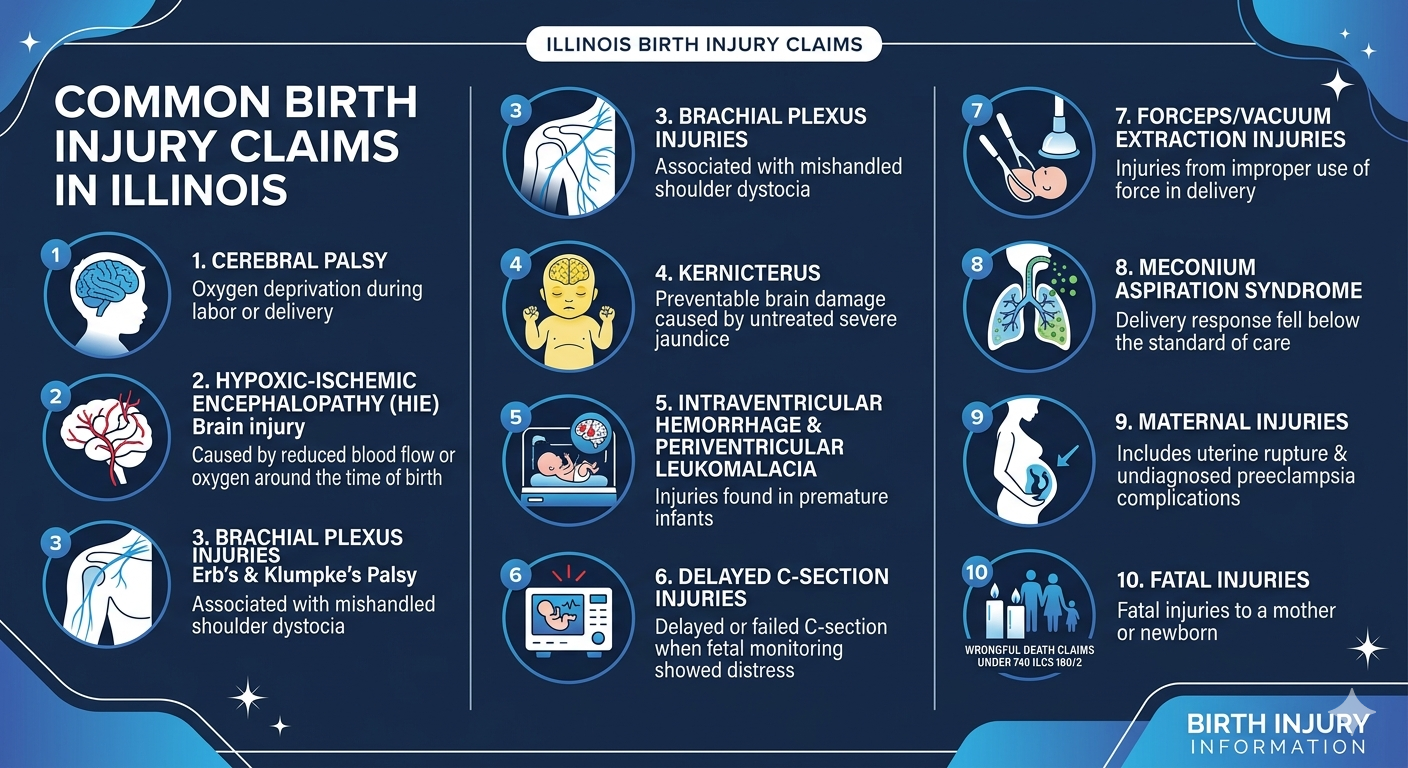
A birth injury is harm to a mother or baby caused by substandard medical care during pregnancy, labor, delivery, or the immediate postpartum period. Illinois birth injury claims commonly involve cerebral palsy from oxygen deprivation, brachial plexus injuries from mishandled shoulder dystocia, kernicterus from untreated jaundice, and harm caused by delayed or failed cesarean section.
The common thread in almost every birth injury case is a deviation from the accepted standard of care — something a reasonably careful obstetrician, nurse, or hospital should have done and did not, or should not have done and did. The medical complication itself is not what makes a claim; the preventable response (or absence of response) does. That distinction is central to how Illinois courts and juries evaluate these cases.
The injury categories we see most often in an Illinois birth injury claim include:
- Cerebral palsy resulting from oxygen deprivation during labor or delivery
- Hypoxic-ischemic encephalopathy (HIE), a brain injury caused by reduced blood flow or oxygen around the time of birth
- Brachial plexus injuries, including Erb’s palsy and Klumpke’s palsy, are often associated with mishandled shoulder dystocia
- Kernicterus, a preventable form of brain damage caused by untreated severe jaundice
- Intraventricular hemorrhage and periventricular leukomalacia in premature infants
- Injuries from delayed or failed cesarean section when fetal monitoring showed distress
- Injuries from improper use of forceps or vacuum extraction
- Meconium aspiration syndrome when the delivery response fell below the standard of care
- Maternal injuries including uterine rupture and complications of undiagnosed preeclampsia
- Fatal injuries to a mother or newborn, which are pursued as wrongful death claims under 740 ILCS 180/2
Common birth injury claims in Illinois
Why do birth injuries happen, and when are they preventable?
Most preventable birth injuries trace to breakdowns in fetal monitoring, delayed recognition of a complication, or the failure to act on information that was available at the time. Not every bad birth outcome is malpractice — some arise from genetic factors, infection, or unavoidable complications. Distinguishing preventable harm from unavoidable outcome is the threshold question in every case.
The numbers help frame the scale of the problem. According to the Centers for Disease Control and Prevention, approximately 3 in every 1,000 children in the United States are diagnosed with cerebral palsy by age 8. Peer-reviewed research published through the National Institutes of Health indicates that hypoxic-ischemic encephalopathy — a leading cause of term-born cerebral palsy — occurs in roughly 1.5 to 2.5 per 1,000 live births in developed countries. Most births in Illinois proceed without serious complication. When something goes wrong, the question is whether the medical team recognized the problem in time and responded the way the standard of care required.
That is also why a birth injury claim in Illinois cannot proceed on a parent’s instinct alone. A qualified physician has to review the medical record and reach an opinion that there is a reasonable and meritorious basis for the case. Until that review is complete, no one — not the family, not the attorney — can say with confidence whether a particular bad outcome crossed the line from unavoidable to preventable.
Where are Illinois birth injury cases filed, and which hospitals are involved?
Illinois birth injury lawsuits are filed in the county where the alleged malpractice occurred. Cook County cases go to the Richard J. Daley Center; Will County cases to the courthouse in Joliet; DuPage County cases to the Wheaton Judicial Center. The firm’s service area includes Chicago’s major birthing institutions and the Level III perinatal centers across the south and west suburbs.
The venue follows the facility where the alleged malpractice happened, not where the family lives or the insurance policy was issued. For a birth at Northwestern Medicine Prentice Women’s Hospital — the largest birthing center in Illinois — the case belongs in the Circuit Court of Cook County at the Richard J. Daley Center in downtown Chicago.
A birth at Advocate Christ Medical Center in Oak Lawn, a Level III perinatal hospital, likewise goes to Cook County, though some Cook County matters involving south-suburban venues are heard at the Fifth Municipal District Bridgeview Courthouse. Births at Silver Cross Hospital in New Lenox go to Will County in Joliet. Births at Edward Hospital, Central DuPage, or other DuPage institutions go to the DuPage Judicial Center in Wheaton.
Children who survive a serious birth injury often receive follow-up care at Ann & Robert H. Lurie Children’s Hospital or at Advocate Children’s Hospital, which operates Level III neonatal intensive care units at its Oak Lawn and Park Ridge campuses. When a birth injury case is built, medical records, imaging, and treatment history from each of these institutions — obstetric care, delivery, NICU, and long-term pediatric follow-up — are pulled together to reconstruct what happened and how it has shaped the child’s life.
Does Illinois cap damages in birth injury cases?
No. In Lebron v. Gottlieb Memorial Hospital (2010), the Illinois Supreme Court struck down statutory caps on non-economic damages in medical malpractice cases as unconstitutional. Illinois juries may award the full measure of damages the evidence supports, including lifetime medical care, lost earning capacity, pain and suffering, and loss of a normal life.
The Lebron decision is worth understanding because it arose from a birth injury itself. Abigaile Lebron sustained severe brain damage and cerebral palsy during her delivery at Gottlieb Memorial Hospital in Melrose Park. Her family challenged the $500,000 cap the Illinois legislature had tried to place on non-economic damages against physicians and the $1 million cap against hospitals. The Illinois Supreme Court held that the legislature could not instruct juries how much the pain and suffering of a catastrophically injured child was worth — that decision belongs to the jury, within the bounds of the evidence.
This matters in a practical way for families. A child with severe cerebral palsy or HIE may need around-the-clock care, specialized equipment, repeated surgeries, and educational support for an entire lifetime. Cost projections in the multi-million-dollar range are not unusual. An Illinois birth injury lawsuit can pursue those numbers without the artificial ceiling that exists in some other states.
What damages can a family recover in an Illinois birth injury claim?
An Illinois birth injury claim can recover both economic and non-economic damages. Economic damages cover lifetime medical care, rehabilitation, therapy, assistive technology, home modifications, specialized education, and future lost earning capacity. Non-economic damages cover the child’s pain and suffering, loss of a normal life, and emotional distress. Illinois places no statutory cap on either category.
Economic damages in a serious birth injury case frequently include:
- Past and future medical expenses, including hospital stays, surgeries, medications, and specialist care
- Physical, occupational, and speech therapy across the child’s lifetime
- Assistive technology and mobility equipment, from communication devices to adaptive wheelchairs
- Home modifications such as wheelchair ramps, accessible bathrooms, and lift systems
- Vehicle modifications to accommodate a child’s medical equipment or mobility needs
- Specialized education costs, including private schools and individualized educational support
- Future lost earning capacity when a child’s ability to work as an adult has been permanently limited
- Parental lost income tied to full-time caregiving responsibilities
Non-economic damages recognize harms that do not come with a bill attached. They include the child’s physical pain and suffering, the loss of a normal life, emotional distress, and — on behalf of parents — loss of consortium and the loss of the relationship the family expected to have. Because of Lebron, Illinois imposes no statutory limit on these awards. Their size is a function of the evidence and the jury’s assessment of what the injury actually means for the child and the family.
What does it take to file a birth injury lawsuit in Illinois?
Illinois requires a physician’s review before a medical malpractice case can be filed. Under 735 ILCS 5/2-622, the complaint must be accompanied by an affidavit and a written report from a qualified health professional stating that there is a reasonable and meritorious cause for the action. Obtaining that report requires early medical record work.
The certificate of merit requirement under 735 ILCS 5/2-622 is the screening mechanism Illinois uses to keep unsupported malpractice cases out of the court system. When the defendant is a physician, the reviewing health professional must be a physician licensed to practice medicine in all its branches, knowledgeable in the relevant specialty, and meeting the expert witness standards set out in 735 ILCS 5/8-2501. The affidavit states that the attorney has consulted with such a professional and that the professional has concluded in a written report that the case has a reasonable and meritorious basis. Missing this step is grounds for dismissal under Section 2-619.
That requirement shapes the practical timeline of a birth injury claim in Illinois. Labor, delivery, and NICU records routinely run to thousands of pages. Records have to be requested from every involved provider — the obstetrician’s office, the delivering hospital, the NICU, and any follow-up specialists. A qualified obstetrician, neonatologist, or pediatric neurologist then needs time to review them. A case that goes to filing has typically been in preparation for months before the complaint is ever drafted. Families who contact legal counsel early give that process room to breathe.
Who can be held responsible for a birth injury in Illinois?
Responsibility for a birth injury in Illinois can rest with the obstetrician, the delivering hospital, labor and delivery nurses, midwives, anesthesiologists, and consulting specialists. Hospital systems may also be liable for understaffing, protocol failures, or credentialing decisions. Identifying every responsible party matters because lifetime care for a severely injured child can exceed a single provider’s insurance limits.
Birth injury litigation is rarely a simple one-on-one case. Labor and delivery is a team activity. A nurse who misread a fetal heart tracing, a physician who delayed responding to a call, and a hospital system that left a busy unit short-staffed may all have contributed to the same outcome. A careful investigation identifies each of those threads and traces them to the people and institutions responsible. Each one may carry its own malpractice insurance policy, and pooling those resources is often necessary to fully fund a child’s lifetime care.
Public and teaching hospitals add their own wrinkles. Cases against county hospitals or Illinois public institutions typically involve shorter deadlines and pre-suit notice requirements under the Local Governmental Tort Immunity Act. Claims involving the University of Illinois Hospital or other state-run institutions may involve the Illinois Court of Claims rather than a standard circuit court. These distinctions change the procedure — but not the underlying question of whether the standard of care was met.
How does our firm handle Illinois birth injury claims?
Fotopoulos Law Office handles Illinois birth injury claims step by step, beginning with a free, confidential consultation followed by medical record collection, expert review, and — only when the evidence supports it — filing suit with the required 622 affidavit. Families pay nothing upfront and owe no fees unless we recover compensation.
Attorney John Fotopoulos previously served as a Cook County Circuit Court Judge, and that experience on the bench informs how our firm evaluates, builds, and presents every case. A judge’s view of a case — what evidence will be credited, which arguments will land, which experts will hold up under cross-examination — is not the same as an advocate’s view from the outside. Attorney Fotopoulos brings both perspectives to the work.
Our process for an Illinois birth injury claim follows a clear sequence:
- Free, confidential consultation. We listen first. Before a family is asked to commit to anything, we make sure we understand what happened, what the medical team has told them, and what they are hoping to accomplish.
- Medical record collection. We gather records from every involved provider — the obstetrician, the delivering hospital, the NICU, and any pediatric specialists following the child.
- Expert review and the 622 affidavit. We work with qualified obstetricians, neonatologists, and pediatric neurologists to review the record. A case moves forward only when a reviewing physician concludes that there is a reasonable and meritorious basis for it.
- Filing and litigation. We file the complaint with the required affidavit and report, conduct discovery, depose the medical providers and hospital staff, and prepare the case as if it will go to trial.
- Most cases resolve through settlement when the evidence supports a fair one. When a fair resolution is not on offer, we are prepared to try the case.
How much does a birth injury lawyer in Illinois cost?
Fotopoulos Law Office handles every Illinois birth injury claim on a contingency basis. Families pay no upfront fees and owe nothing unless we recover compensation for their child. Initial consultations are free and confidential. This structure exists so that families focused on caring for an injured child can pursue a claim without added financial pressure.
A contingency arrangement means our firm is paid only from the recovery we obtain — whether that comes through a negotiated settlement or a verdict at trial. Case expenses, including medical record fees, expert witness costs, and court filing fees, are handled by our firm during the case and reimbursed from the recovery at the end. Families never have to choose between pursuing a claim and paying for their child’s medical care. The two do not compete for the same dollars.
Frequently Asked Questions
Does every bad birth outcome mean there was malpractice?
No. Many difficult birth outcomes occur despite appropriate care. Unexpected complications, genetic factors, maternal infections, and placental issues can cause serious harm even when the medical team does everything right. The purpose of the certificate-of-merit process under 735 ILCS 5/2-622 is to separate unavoidable outcomes from preventable harm, with a qualified physician’s review as the gating step.
What if my child’s diagnosis came years after birth?
That is a common scenario. Subtle motor deficits, learning disabilities, and developmental delays often emerge only when a child reaches milestones that their peers are already hitting. Illinois accounts for this under 735 ILCS 5/13-212(b) by giving families eight years from the date of the alleged negligent act, with an outside limit of the child’s 22nd birthday. A late diagnosis does not automatically close the door.
Do I have to sue the doctors who delivered my child?
A birth injury claim in Illinois is filed against the providers whose care fell below the accepted standard. That does not mean a family is personally attacking providers they worked with in good faith. Claims are almost always paid through the provider’s malpractice insurance, not from personal assets, and our firm handles communication with the insurers so families do not have to.
Will I have to testify about what happened during labor and delivery?
Most birth injury cases involve parent depositions, which are conducted in a conference room with attorneys present rather than in a courtroom. The great majority of cases resolve before trial, so formal courtroom testimony is not required in most matters. When a case does proceed to trial, our firm prepares families thoroughly and stands with them through every step of the process.
What if the hospital was a county facility or a teaching hospital?
Claims against county-owned hospitals and public health systems fall under the Local Governmental Tort Immunity Act, which shortens the filing deadline to one year under 745 ILCS 10/8-101 and adds procedural notice requirements. Claims against state-run facilities like the University of Illinois Hospital may proceed through the Illinois Court of Claims. Early legal consultation matters most in these cases, where procedural deadlines are tighter.
How long does a birth injury lawsuit in Illinois usually take?
Birth injury cases commonly take two to four years from intake to resolution because of the record volume, the expert review process, and the complexity of valuing lifetime damages. Cases involving a child whose medical condition is still evolving may take longer because the full picture of future medical needs has to be clear before a case can be fairly resolved. We keep families informed throughout.
Contact Our Illinois Birth Injury Lawyers
If your child was harmed at birth, or if a diagnosis years later has made sense of what happened in the delivery room, we are ready to listen. Call (708) 942-8400 for a free, confidential consultation with our legal team. Our Orland Park office is located at 14496 John Humphrey Drive, Suite 101, Orland Park, IL 60462. We serve clients throughout Illinois, including Chicago, Orland Park, Tinley Park, Joliet, Glen Ellyn, and the surrounding counties.